

 Image 1 of 4
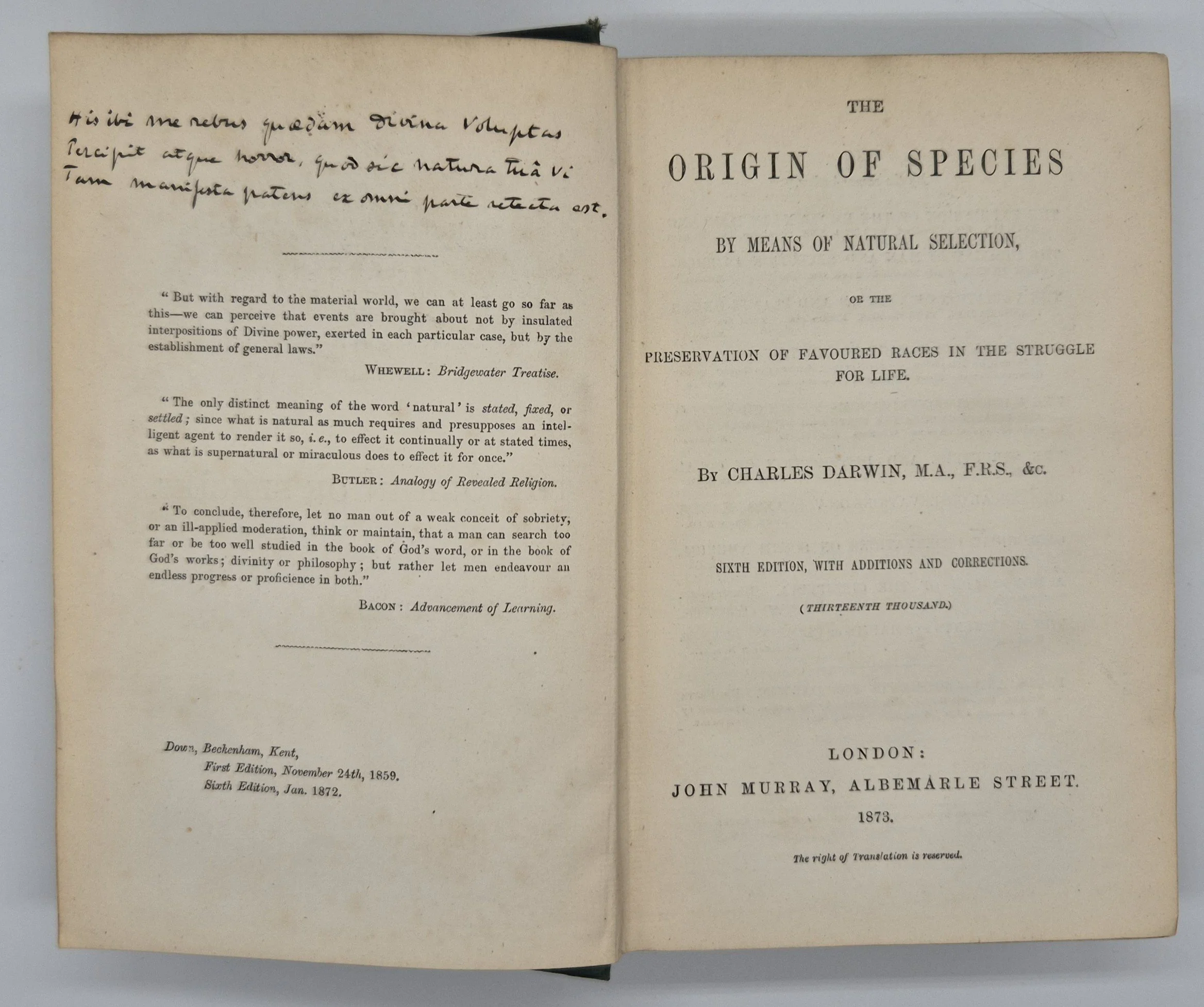 Image 2 of 4
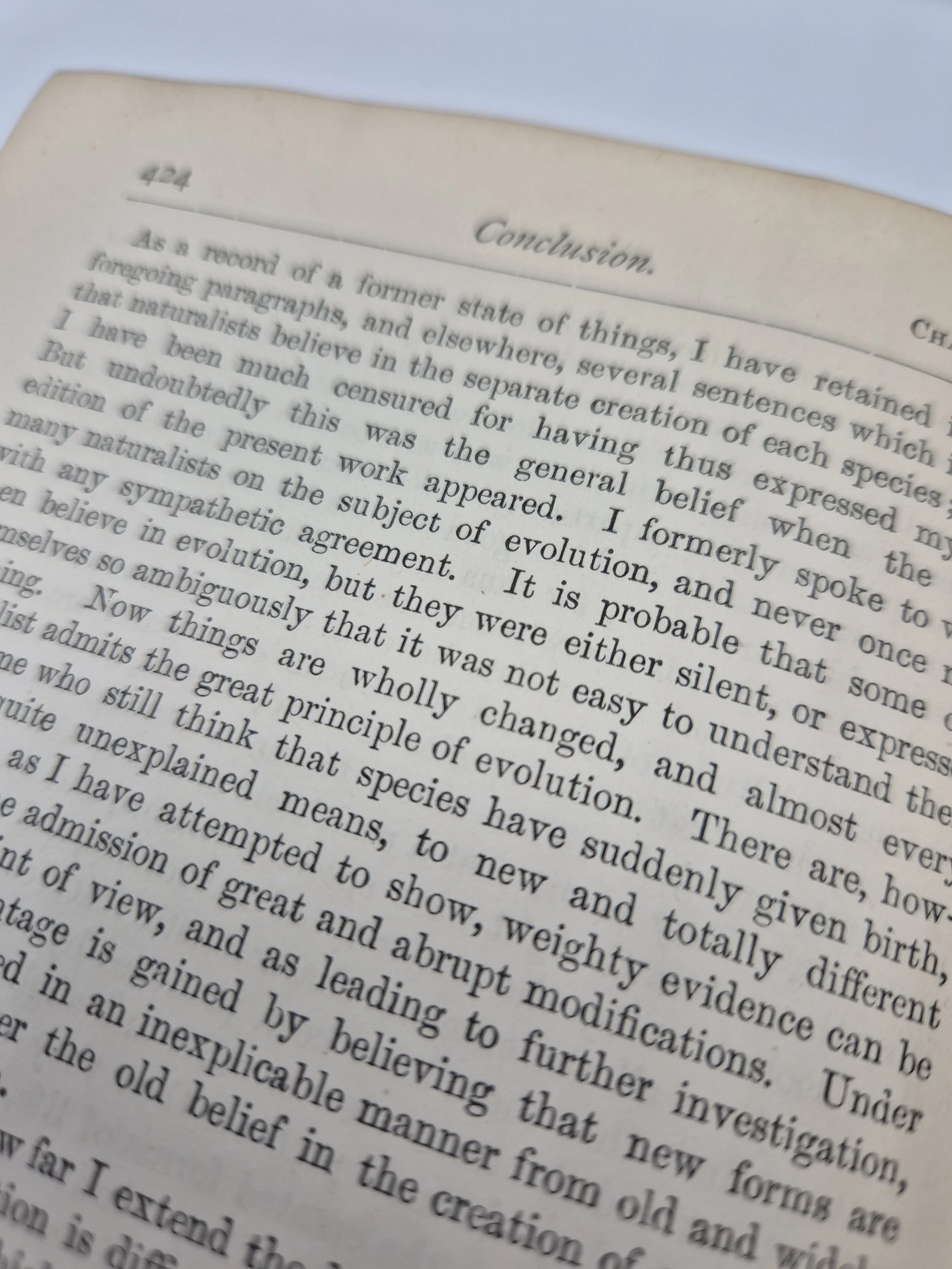 Image 3 of 4
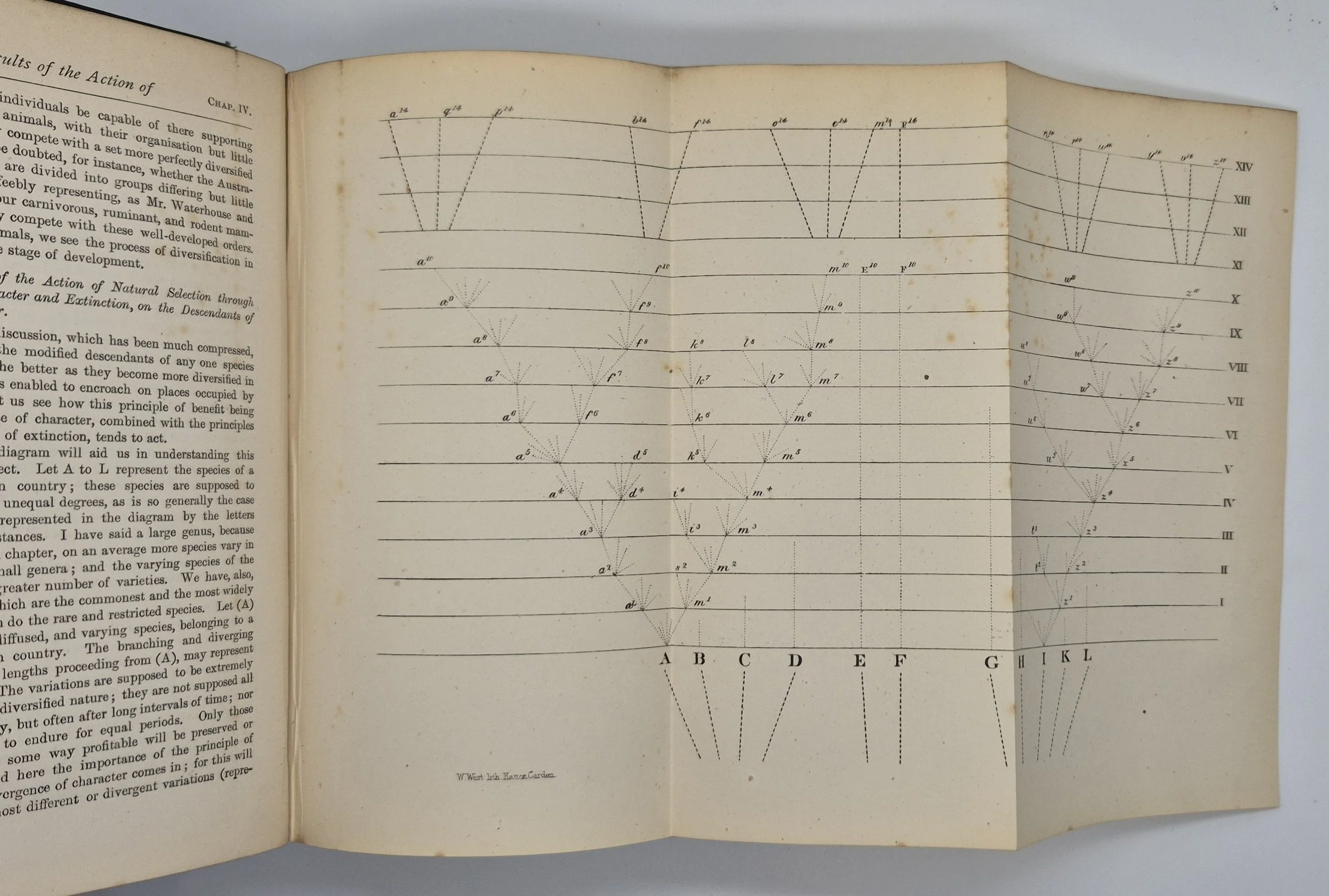 Image 4 of 4
DARWIN, Charles
The Origin of Species by means of Natural Selection, or the Preservation of Favoured Races in the Struggle for Life
London: John Murray, 1873
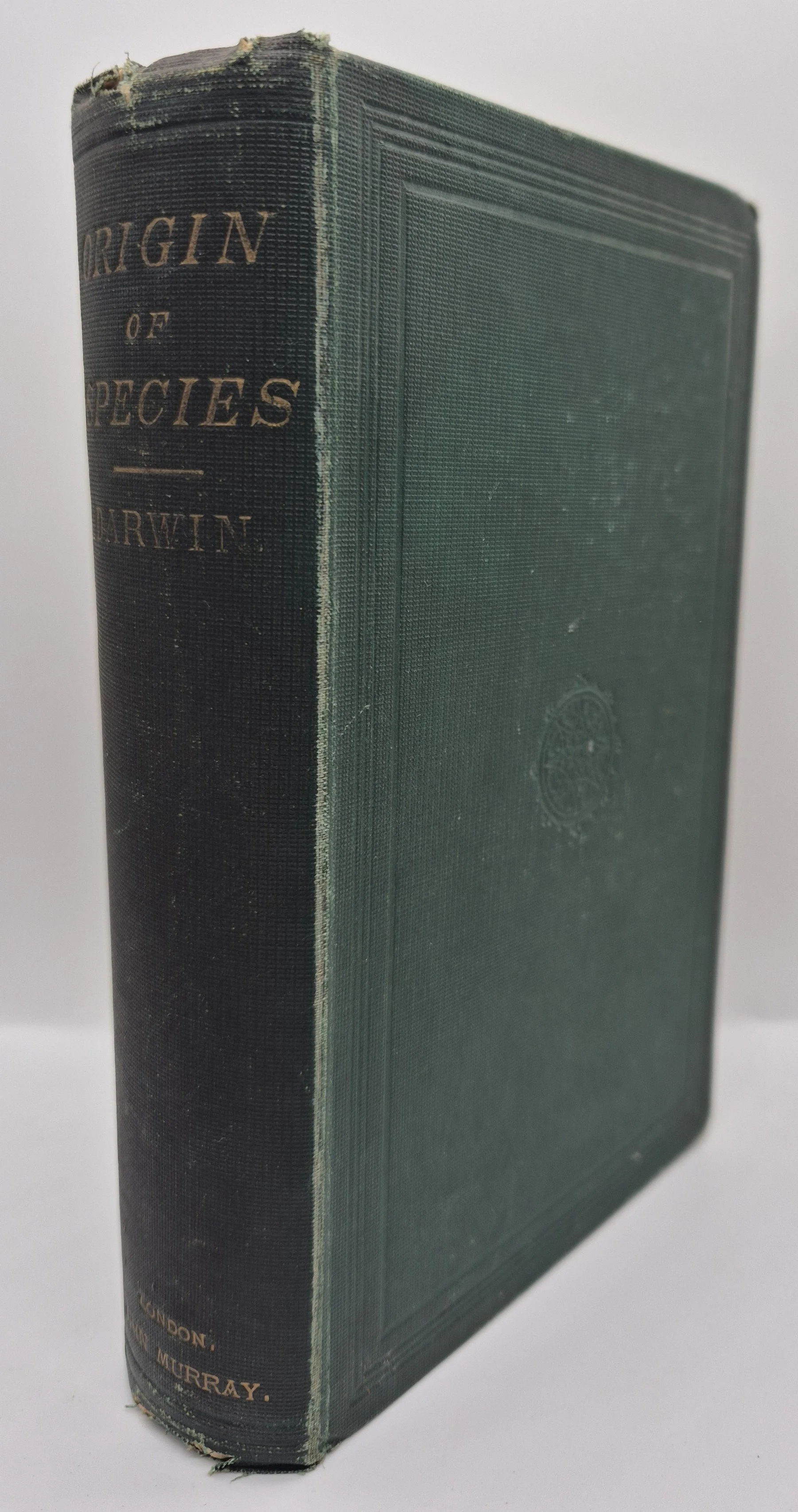
8vo., original green publisher’s cloth, ruled in blind to boards with central embossed device to both; lettered in gilt to spine; brown endpapers; pp. [v], vi-xxi, [ii], 2-458, [i], 2-32 [ads]; complete with the folding lithographic chart to face p. 90; a very good example, the boards a little rubbed, particularly along the spine, with some nicks and short splits to the cloth at tips; small bumps to corners with a little of the boards showing through; hinges starting, a little webbing showing through (but holding); internally very clean, with a little spotting to endleaves and chart; upper edge a little darkened; with two previous owner’s signatures in pencil to half title; one previous owner has neatly penned a particularly poignant quote to face title: “his ibi me rebus quaedam divina voluptas percipit atque horror, quod sic natura tua vi tam manifesta patens ex omni parte retecta est”.
Sixth edition, thirteenth thousand. Loosely translated, the added quotation reads:
“There upon from all these things a sort of divine delight gets hold upon me and a shuddering, because nature thus by your power has been so manifestly laid open and uncovered in every part.”
A very good example of the important sixth edition of Darwin’s Origin of Species, famously cited as being the first copy of this particular title to use the term ‘Evolution’ (appearing twice on pages 201 and three times on page 424). The term had, however, been used in his Variation under domestication (1868, vol. 2, p.60) though with a different meaning.
Darwin’s Origin of Species is widely regarded as one of the most important scientific works of all time, and is the cornerstone of Evolutionary Biology. When it first appeared, on the 24th November 1859, it sent shockwaves through the scientific community, in particular raised questions regarding the role of science and its relationship with the Church of England, his treatise conflicting with views that humans were unique beings, who should be viewed separately to animals. In 1871, Darwin followed the work with ‘The Descent of Man’, which applied his evolutionary theory to humans, once again sparking active debate. By the end of that same year, he turned his attention back to his ‘Origin’, beginning work on his sixth edition - an edition which would later become the authoritative edition, and the source text for almost all later editions published in his lifetime.
With ‘On’ dropped from the title, Darwin finally acknowledged his theories as the affirmative theory for the origin of species. He added an additional 571 words, with the total word count shooting up to almost 17,000. Furthermore, a Glossary was added, making it more accessible to readers. Most significantly, however, Darwin adds a new chapter (7) in response to (Roman Catholic Biologist) Mivart's Genesis of species, and a further rebuttal of Lord Kelvin's views on Earth history.
An important edition, in the relatively early thirteenth thousand state.
DARWIN, Charles
The Origin of Species by means of Natural Selection, or the Preservation of Favoured Races in the Struggle for Life
London: John Murray, 1873
8vo., original green publisher’s cloth, ruled in blind to boards with central embossed device to both; lettered in gilt to spine; brown endpapers; pp. [v], vi-xxi, [ii], 2-458, [i], 2-32 [ads]; complete with the folding lithographic chart to face p. 90; a very good example, the boards a little rubbed, particularly along the spine, with some nicks and short splits to the cloth at tips; small bumps to corners with a little of the boards showing through; hinges starting, a little webbing showing through (but holding); internally very clean, with a little spotting to endleaves and chart; upper edge a little darkened; with two previous owner’s signatures in pencil to half title; one previous owner has neatly penned a particularly poignant quote to face title: “his ibi me rebus quaedam divina voluptas percipit atque horror, quod sic natura tua vi tam manifesta patens ex omni parte retecta est”.
Sixth edition, thirteenth thousand. Loosely translated, the added quotation reads:
“There upon from all these things a sort of divine delight gets hold upon me and a shuddering, because nature thus by your power has been so manifestly laid open and uncovered in every part.”
A very good example of the important sixth edition of Darwin’s Origin of Species, famously cited as being the first copy of this particular title to use the term ‘Evolution’ (appearing twice on pages 201 and three times on page 424). The term had, however, been used in his Variation under domestication (1868, vol. 2, p.60) though with a different meaning.
Darwin’s Origin of Species is widely regarded as one of the most important scientific works of all time, and is the cornerstone of Evolutionary Biology. When it first appeared, on the 24th November 1859, it sent shockwaves through the scientific community, in particular raised questions regarding the role of science and its relationship with the Church of England, his treatise conflicting with views that humans were unique beings, who should be viewed separately to animals. In 1871, Darwin followed the work with ‘The Descent of Man’, which applied his evolutionary theory to humans, once again sparking active debate. By the end of that same year, he turned his attention back to his ‘Origin’, beginning work on his sixth edition - an edition which would later become the authoritative edition, and the source text for almost all later editions published in his lifetime.
With ‘On’ dropped from the title, Darwin finally acknowledged his theories as the affirmative theory for the origin of species. He added an additional 571 words, with the total word count shooting up to almost 17,000. Furthermore, a Glossary was added, making it more accessible to readers. Most significantly, however, Darwin adds a new chapter (7) in response to (Roman Catholic Biologist) Mivart's Genesis of species, and a further rebuttal of Lord Kelvin's views on Earth history.
An important edition, in the relatively early thirteenth thousand state.