

 Image 1 of 2
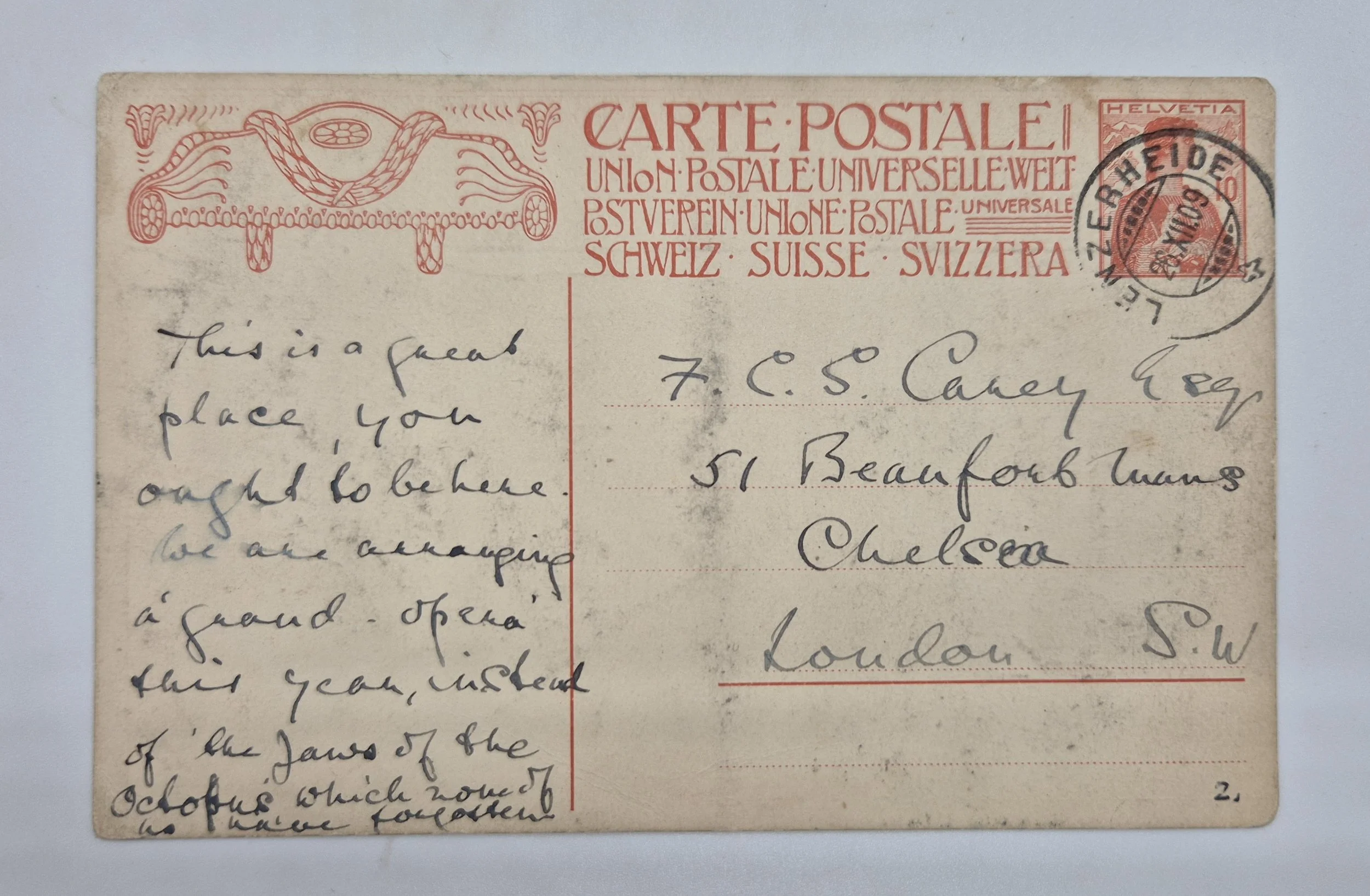 Image 2 of 2
Signed postcard from Rupert Brooke and numerous other friends to Francis Clive Savill Carey
SIGNED BY RUPERT BROOKE AND FRIENDS TO THEIR UNIVERSITY CONTEMPORARY FRANCIS CAREY
[BROOKE, Rupert] et al.
Signed postcard from Rupert Brooke and numerous other friends to Francis Clive Savill Carey
Lenzerheide (Switzerland), 1909
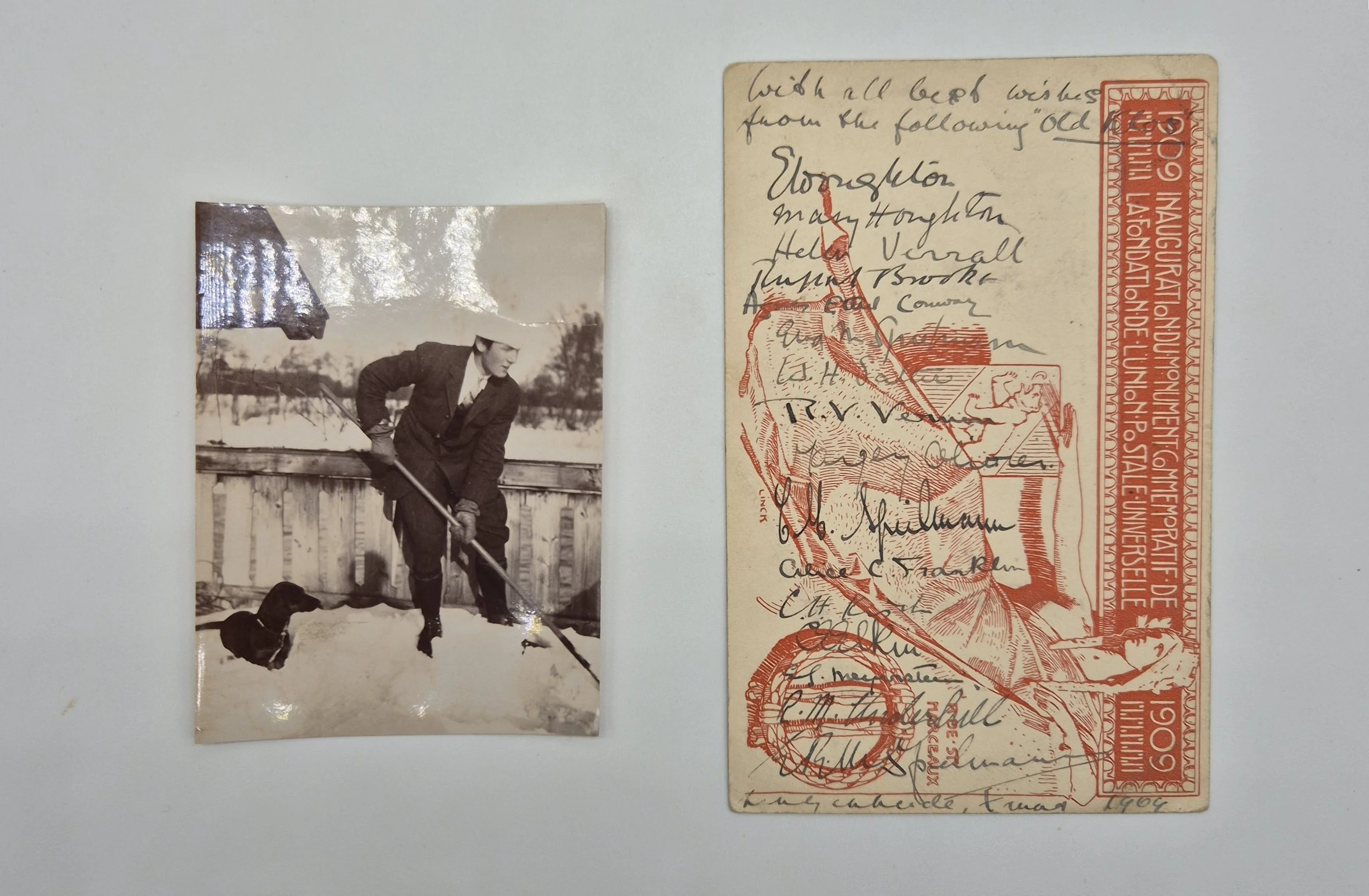
A single postcard (14 x 9cm approx) printed on one side in red with ‘Carte Postale Union Postale Universelle Welt Postverein Unione Postale Universale Schweiz. Suisse. Svizzera’, together with lines and decorative devices to one side, and an image showing the inauguration of a commemorative monument to the founding of the Postal Union in 1909 to the verso; with address of F. C. S. Carey Esq. and message to recto, along with the contemporary postal stamp; and end of message to verso along with the 16 signatures; a little rubbed and scuffed in accordance with age, but an excellent example nonetheless.
[together with]
A black and white sepia photograph (7.5 x 10cm approx); showing a man in a hat with a black dog shoveling snow; with ‘W Denis Browne / Jan 1913’ written in pencil to verso; small tape residue stain to verso; and one 2.5cm tear to outer edge; very good.
An original postcard written by Rupert Brooke and others during their time in Switzerland. Dated in 1909, the message reads: “This is a good place, you ought to be here. We are arranging a grand opera this year, instead of the Jaws of the Octopus which some of us have forgotten. With all good wishes from the following Old Klos”. The card is then signed by sixteen of the friends which include Mary Haughton, Helen Verrall, Rupert Brooke, Agnes Ethel Conway, W.H. Salter, Margery Olivier, Alice Franklin and several others.
The photograph shows William Denis Browne (1888-1915), a British composer and musician who was one of Rupert Brooke’s closest friends. The pair had first met at Rugby School, where Browne had suggested to the young Brooke that he write a poem for him to set to music for Easter Day, the resulting work being ‘A song in praise of Cremation written to my lady on Easter Day’. Later, they both studied at Cambridge, where they met the Clive Clarey to whom the card is addressed, and also took part in several theatrical productions. During 1913 and 1914 they travelled together throughout Europe, which is presumably when this photograph was taken. Shortly after the First World War, they were commissioned together into Royal Naval Division. During one of their early voyages, and after contracting sepsis from an infected mosquito bite, Brooke died on the 23rd April 1915, with Browne by his side. “I sat with Rupert”, Browne later wrote. “At 4 o’clock he became weaker, and at 4.46 he died, with the sun shining all round his cabin, and the cool sea breeze blowing through the door and the shaded windows. No one could have wished for a quieter or a calmer end than in that lovely bay, shielded by the mountains and fragrant with sage and thyme.” After being injured twice during the Gallipoli Campaign in May and June 1915, Browne sent the following letter home: “I’ve gone now too; not too badly I hope. I’m luckier than Rupert, because I’ve fought.” His body was never found.
Between 1907 and 1909, Brooke spent three consecutive Christmases in Switzerland, mostly with an ever-growing circle of friends which included Helen Verrall, Herbert Samuel, and the Olivier sisters, Noel and Margery, as well as socialist acquaintances from Cambridge and members of the Bloomsbury Group. The location, of Klosters in the Engadine, was where they together staged a play in 1908, ‘From the Jaws of the Octopus’, written and performed in just nine days with ‘Armour and Explosives by the entire cast’ (Hassall, p. 173). Though the text was predominantly written by Helen Verrall (who has also signed this card), Brooke certainly had a lot of input, and performed the role of the hero, Eugene de Montmorency. They then saw in the New Year of 1909 together. This card was written the following year, when Brooke returned to pursue his love interest at the time, Noel Olivier, and another performance was arranged by the then-named group, the ‘Old Klos’.
Francis Clive Savill Carey (1883 – 1968) met Brooke and Browne whilst studying at Clare college, Cambridge, and was responsible for attempting to teach the young Brooke to sing. Brooke had taken an active interest in Greek plays and the Marlowe Society in its early days, and it was Carey who was responsible for arranging the music and choral works directed by Brooke for the Cambridge University plays during the same time. Later, Carey went on to study at the Royal College of Music.
Other signatures included in this card include Margery Oliver, cousin of Lawrence, who along with her sister was a prominent member of the Bloomsbury group and referred to by Virginia Woolf as ‘Neo-Pagans’; and Alice Franklin, a pacifist and another associate of Woolf and the Bloomsbury group members who held a famously critical view of Brooke’s post-war memoirs; and Helen Verrall (1883-1959), who during her time at Cambridge had helped Brooke more specifically with his comic plays.
Brooke’s signature is rarely available, and to find with such association to his early contemporaries at Cambridge is rare indeed.
SIGNED BY RUPERT BROOKE AND FRIENDS TO THEIR UNIVERSITY CONTEMPORARY FRANCIS CAREY
[BROOKE, Rupert] et al.
Signed postcard from Rupert Brooke and numerous other friends to Francis Clive Savill Carey
Lenzerheide (Switzerland), 1909
A single postcard (14 x 9cm approx) printed on one side in red with ‘Carte Postale Union Postale Universelle Welt Postverein Unione Postale Universale Schweiz. Suisse. Svizzera’, together with lines and decorative devices to one side, and an image showing the inauguration of a commemorative monument to the founding of the Postal Union in 1909 to the verso; with address of F. C. S. Carey Esq. and message to recto, along with the contemporary postal stamp; and end of message to verso along with the 16 signatures; a little rubbed and scuffed in accordance with age, but an excellent example nonetheless.
[together with]
A black and white sepia photograph (7.5 x 10cm approx); showing a man in a hat with a black dog shoveling snow; with ‘W Denis Browne / Jan 1913’ written in pencil to verso; small tape residue stain to verso; and one 2.5cm tear to outer edge; very good.
An original postcard written by Rupert Brooke and others during their time in Switzerland. Dated in 1909, the message reads: “This is a good place, you ought to be here. We are arranging a grand opera this year, instead of the Jaws of the Octopus which some of us have forgotten. With all good wishes from the following Old Klos”. The card is then signed by sixteen of the friends which include Mary Haughton, Helen Verrall, Rupert Brooke, Agnes Ethel Conway, W.H. Salter, Margery Olivier, Alice Franklin and several others.
The photograph shows William Denis Browne (1888-1915), a British composer and musician who was one of Rupert Brooke’s closest friends. The pair had first met at Rugby School, where Browne had suggested to the young Brooke that he write a poem for him to set to music for Easter Day, the resulting work being ‘A song in praise of Cremation written to my lady on Easter Day’. Later, they both studied at Cambridge, where they met the Clive Clarey to whom the card is addressed, and also took part in several theatrical productions. During 1913 and 1914 they travelled together throughout Europe, which is presumably when this photograph was taken. Shortly after the First World War, they were commissioned together into Royal Naval Division. During one of their early voyages, and after contracting sepsis from an infected mosquito bite, Brooke died on the 23rd April 1915, with Browne by his side. “I sat with Rupert”, Browne later wrote. “At 4 o’clock he became weaker, and at 4.46 he died, with the sun shining all round his cabin, and the cool sea breeze blowing through the door and the shaded windows. No one could have wished for a quieter or a calmer end than in that lovely bay, shielded by the mountains and fragrant with sage and thyme.” After being injured twice during the Gallipoli Campaign in May and June 1915, Browne sent the following letter home: “I’ve gone now too; not too badly I hope. I’m luckier than Rupert, because I’ve fought.” His body was never found.
Between 1907 and 1909, Brooke spent three consecutive Christmases in Switzerland, mostly with an ever-growing circle of friends which included Helen Verrall, Herbert Samuel, and the Olivier sisters, Noel and Margery, as well as socialist acquaintances from Cambridge and members of the Bloomsbury Group. The location, of Klosters in the Engadine, was where they together staged a play in 1908, ‘From the Jaws of the Octopus’, written and performed in just nine days with ‘Armour and Explosives by the entire cast’ (Hassall, p. 173). Though the text was predominantly written by Helen Verrall (who has also signed this card), Brooke certainly had a lot of input, and performed the role of the hero, Eugene de Montmorency. They then saw in the New Year of 1909 together. This card was written the following year, when Brooke returned to pursue his love interest at the time, Noel Olivier, and another performance was arranged by the then-named group, the ‘Old Klos’.
Francis Clive Savill Carey (1883 – 1968) met Brooke and Browne whilst studying at Clare college, Cambridge, and was responsible for attempting to teach the young Brooke to sing. Brooke had taken an active interest in Greek plays and the Marlowe Society in its early days, and it was Carey who was responsible for arranging the music and choral works directed by Brooke for the Cambridge University plays during the same time. Later, Carey went on to study at the Royal College of Music.
Other signatures included in this card include Margery Oliver, cousin of Lawrence, who along with her sister was a prominent member of the Bloomsbury group and referred to by Virginia Woolf as ‘Neo-Pagans’; and Alice Franklin, a pacifist and another associate of Woolf and the Bloomsbury group members who held a famously critical view of Brooke’s post-war memoirs; and Helen Verrall (1883-1959), who during her time at Cambridge had helped Brooke more specifically with his comic plays.
Brooke’s signature is rarely available, and to find with such association to his early contemporaries at Cambridge is rare indeed.