

 Image 1 of 1
MANN, Erika; Thomas MANN [Intro.]
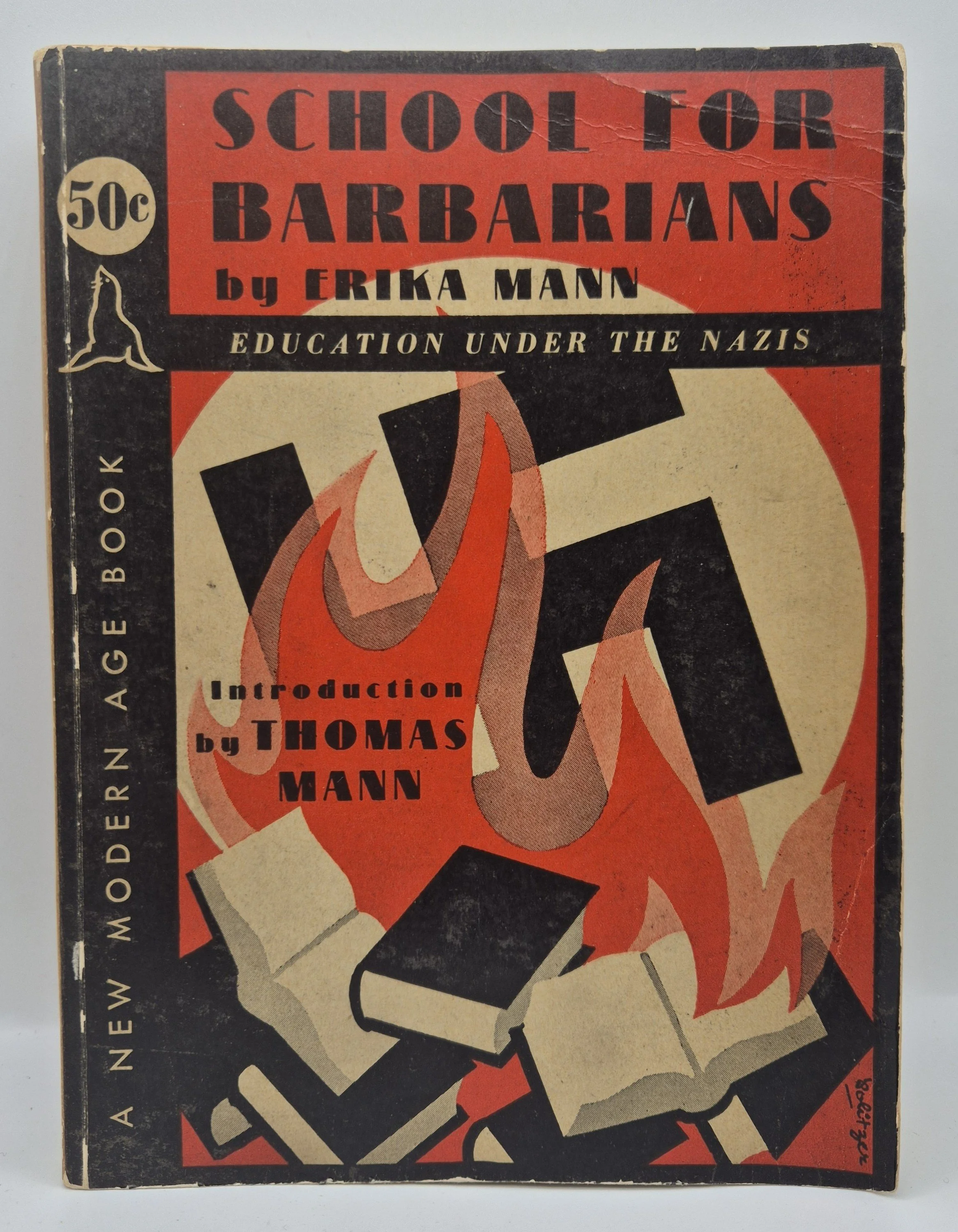
School for Barbarians: Education under the Nazis
New York: Modern Age Books, 1938
Small square 8vo., original illustrative black and red wraps, lettered in black and white to both upper cover and spine, with publisher’s device to lower; pp. [iv], 5-159, [i]; a very good copy, overall, clean and square, with minimal darkening, rubbing, and creasing to edges of covers; spine evenly faded, as is common, with some rubbing to tips; internally also very good, evenly toned, with contemporary ownership name in black ink to the inside front cover.
First UK edition.
“This book damningly shows how far he [Hitler] has gone toward warping pliable young minds into the monstrous Nazi pattern”. Thus begins the synopsis for this political textbook on the subject of the indoctrination of German youth in schools, youth movements, and within the family setting during the 1930s. Published in the year in which Nazi power was nearing its zenith, the author here documents the alienation of children from their parents, the promotion of notions including racial superiority, and the developing of cult personality, among many other subjects.
Mann (1905-1969) was well placed to discuss these issues. Born in Germany and educated as part of a generation of German youth, her father was the author Thomas Mann, a fervent and outspoken critic of Hitler and facism. Erika later became a pupil of Max Reinhardt, and in 1933 she founded the political cabaret, ‘Peppermill’, which ran for over 1000 performances in six countries. That same year, the Mann family fled to Switzerland, and in 1935 Erika married W. H. Auden. In 1936 the couple emigrated to America, where Erika continued to give lectures against National Socialism. In 1945-6 she also became the only woman to report on the Nuremberg war crimes trials.
The introduction is here given by Thomas Mann, who writes of his daughter’s work, who writes that it “enfolds the unlovely facts in a grace of style and a critical lucidity; and most consolingly opposes to the shocking and negative qualities of malice and falsity the positive and righteous force of a reason and human goodness”.
A very nice copy.
MANN, Erika; Thomas MANN [Intro.]
School for Barbarians: Education under the Nazis
New York: Modern Age Books, 1938
Small square 8vo., original illustrative black and red wraps, lettered in black and white to both upper cover and spine, with publisher’s device to lower; pp. [iv], 5-159, [i]; a very good copy, overall, clean and square, with minimal darkening, rubbing, and creasing to edges of covers; spine evenly faded, as is common, with some rubbing to tips; internally also very good, evenly toned, with contemporary ownership name in black ink to the inside front cover.
First UK edition.
“This book damningly shows how far he [Hitler] has gone toward warping pliable young minds into the monstrous Nazi pattern”. Thus begins the synopsis for this political textbook on the subject of the indoctrination of German youth in schools, youth movements, and within the family setting during the 1930s. Published in the year in which Nazi power was nearing its zenith, the author here documents the alienation of children from their parents, the promotion of notions including racial superiority, and the developing of cult personality, among many other subjects.
Mann (1905-1969) was well placed to discuss these issues. Born in Germany and educated as part of a generation of German youth, her father was the author Thomas Mann, a fervent and outspoken critic of Hitler and facism. Erika later became a pupil of Max Reinhardt, and in 1933 she founded the political cabaret, ‘Peppermill’, which ran for over 1000 performances in six countries. That same year, the Mann family fled to Switzerland, and in 1935 Erika married W. H. Auden. In 1936 the couple emigrated to America, where Erika continued to give lectures against National Socialism. In 1945-6 she also became the only woman to report on the Nuremberg war crimes trials.
The introduction is here given by Thomas Mann, who writes of his daughter’s work, who writes that it “enfolds the unlovely facts in a grace of style and a critical lucidity; and most consolingly opposes to the shocking and negative qualities of malice and falsity the positive and righteous force of a reason and human goodness”.
A very nice copy.