

 Image 1 of 4
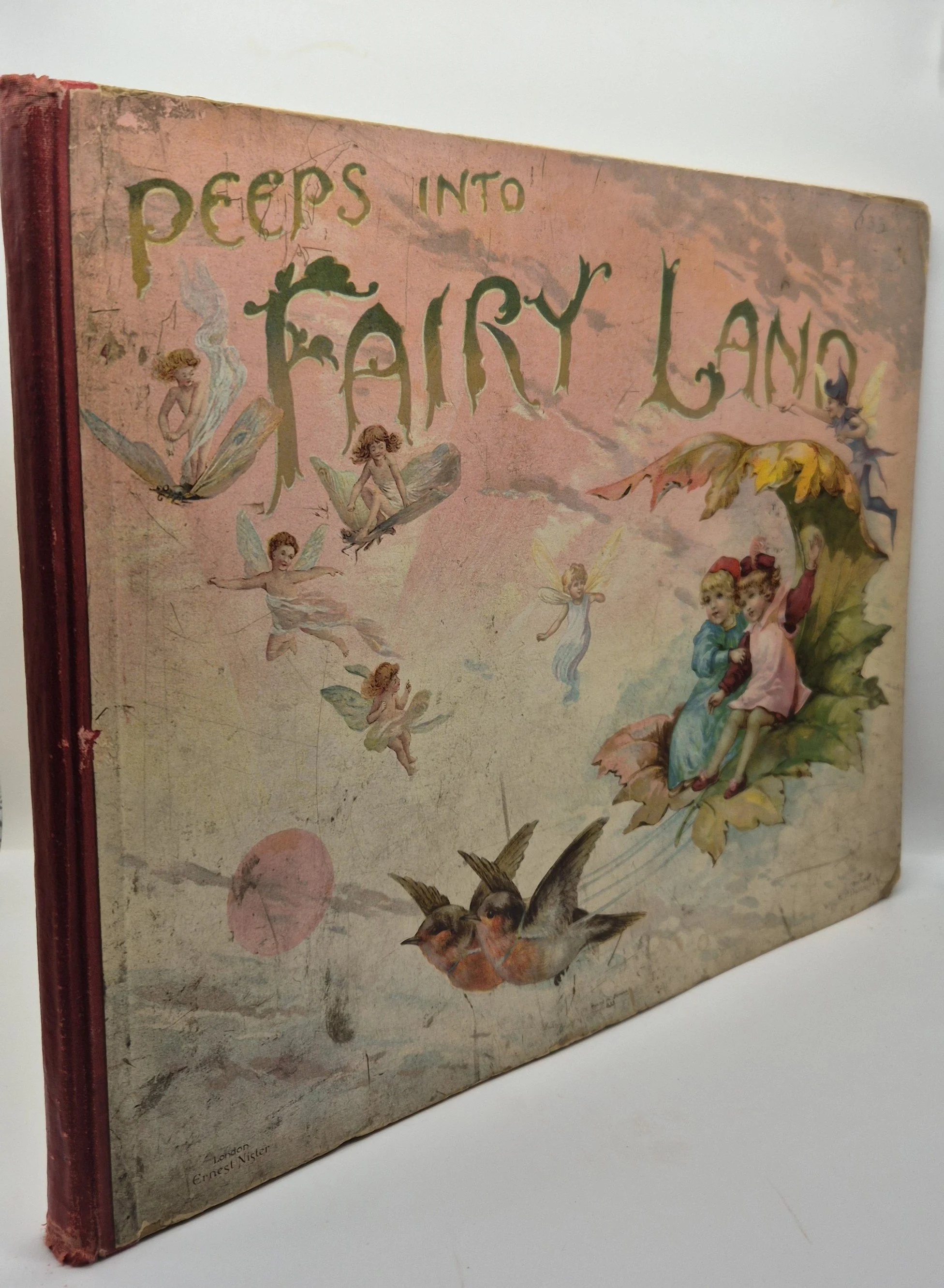 Image 2 of 4
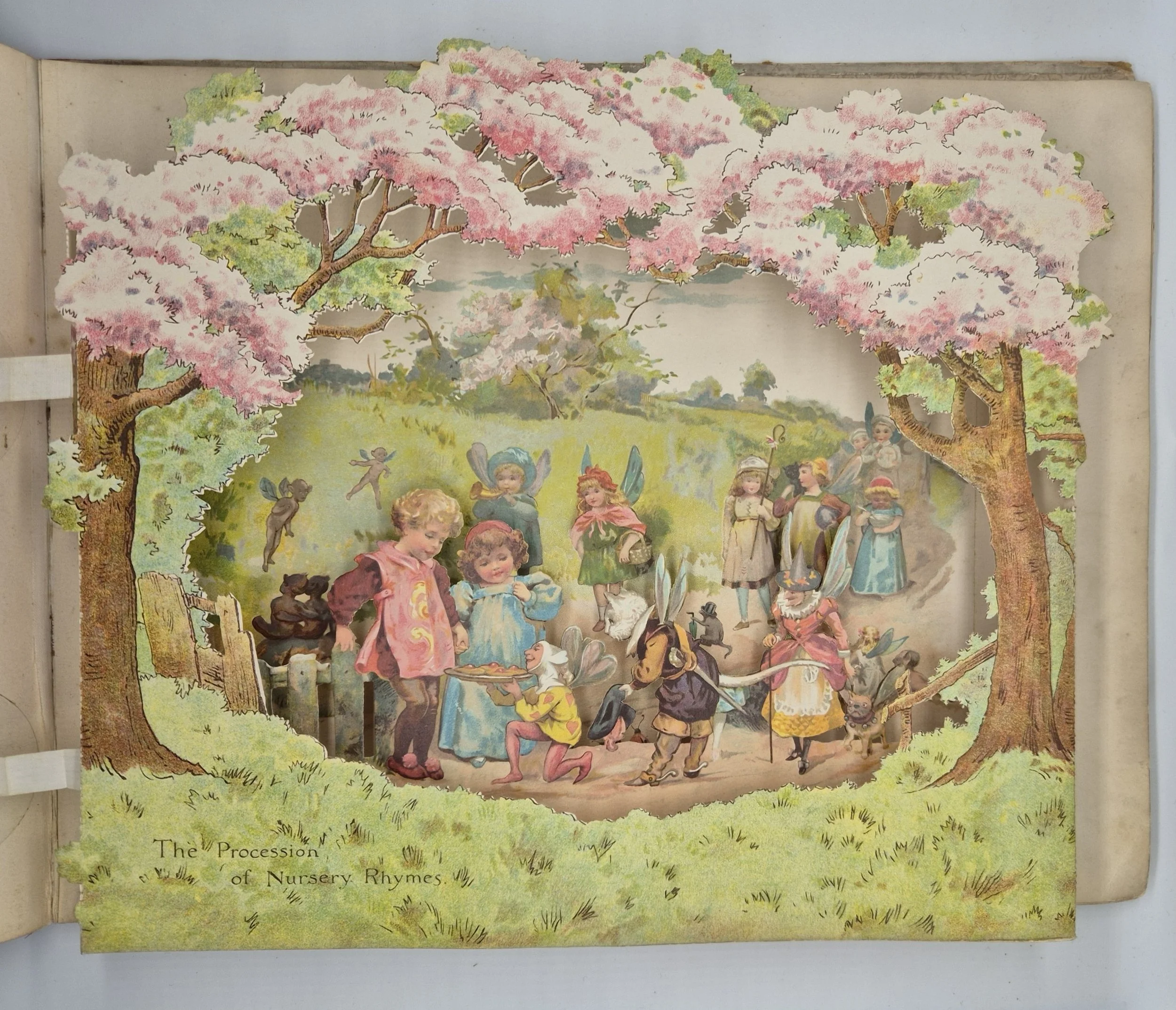 Image 3 of 4
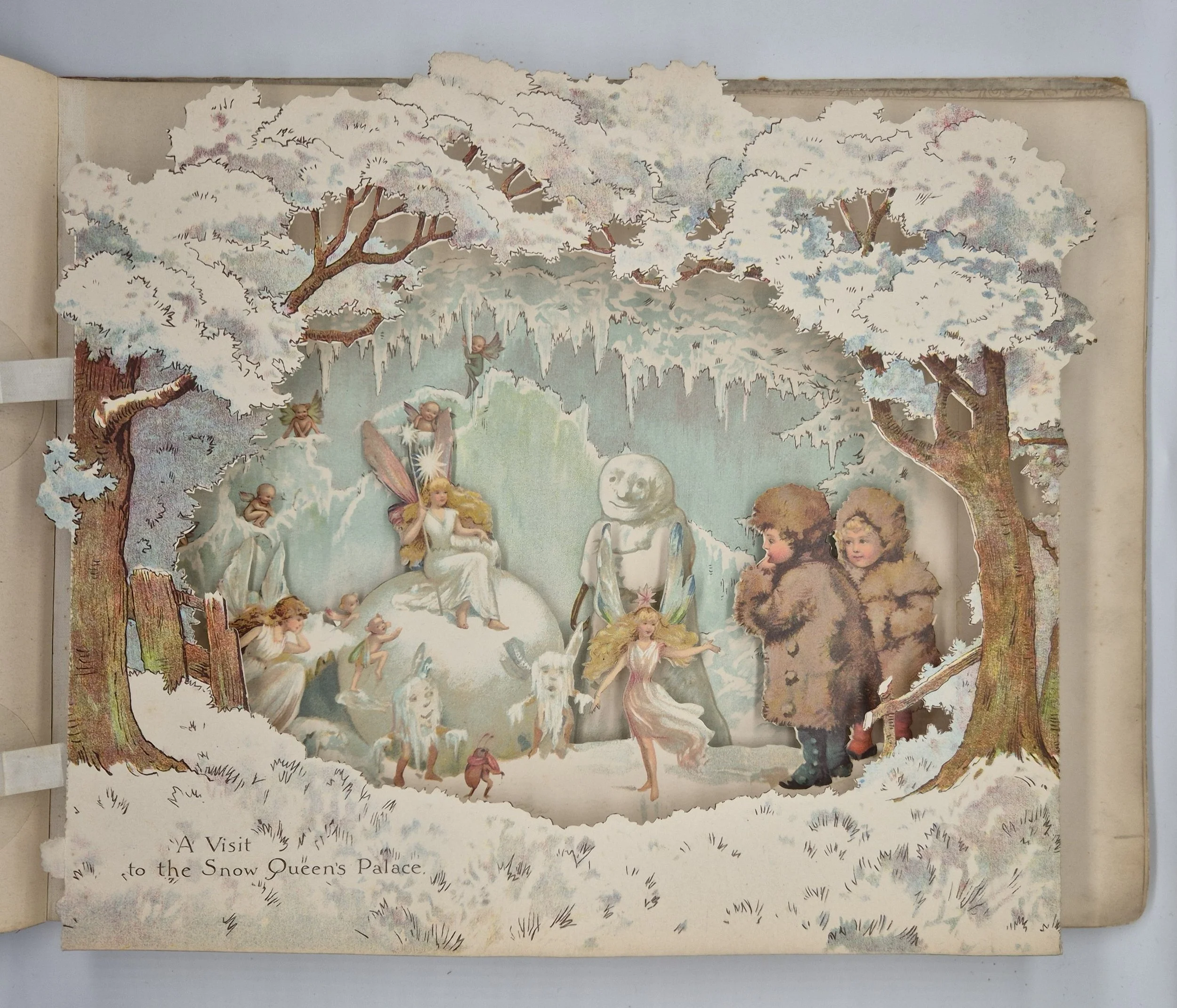 Image 4 of 4
[POP UP BOOK]; F. E. WEATHERLY [Intro.]
Peeps into Fairy Land. A Panorama Picture Book of Fairy Stories.
London: Ernest Nister & New York, E. P. Dutton & Co., [c.1895]
Oblong folio., publisher’s decorative pictorial boards featuring two children aboard a leaf being pulled by harnessed robins; surrounded by a series of fairy folk; backed in red cloth; decorative floral endpapers; unpaginated [pp. xxviii]; illustrated title with line drawings, and further drawings in line surrounding text throughout; as well as six astonishing full-colour pop up lithographs, affixed to facing pages using tabs and creating multi-tiered scenes; the boards rather scratched and marked, as is common, ‘633’ (the number of the publication) written faintly to upper board; with some creases to the illustration and rubbing to corners and edges of boards showing some of the boards beneath; cloth nicked and faded at spine tips; a couple of small patches of wear; internally a very clean copy, with the hinges just a little cracked in places, very discretely repaired in places with archival tape; a little toning and fingers marking to the story pages, the pop ups themselves in fine, bright condition, fully functioning as issued; a lovely example of a work seldomly found with the pop ups in such bright condition.
First, and likely sole edition of this collection of fairy stories, printed in Bavaria. In order, the contained tales are:
Naughty Noel
The Fairy Fir-cones
The Fly-away Flock
Jack and the Beanstalk
The Blue Bird
and
The Babes in the Wood
The pop ups are:
The procession of Nursery Rhymes (featuring cherry blossom trees surrounding a scene with numerous children and fairy figures and animals)
A Visit to the Snow Queen’s Palace (showing two children in a wintry scene, adorned in fur coats, meeting a snow fairy sitting on a snowball)
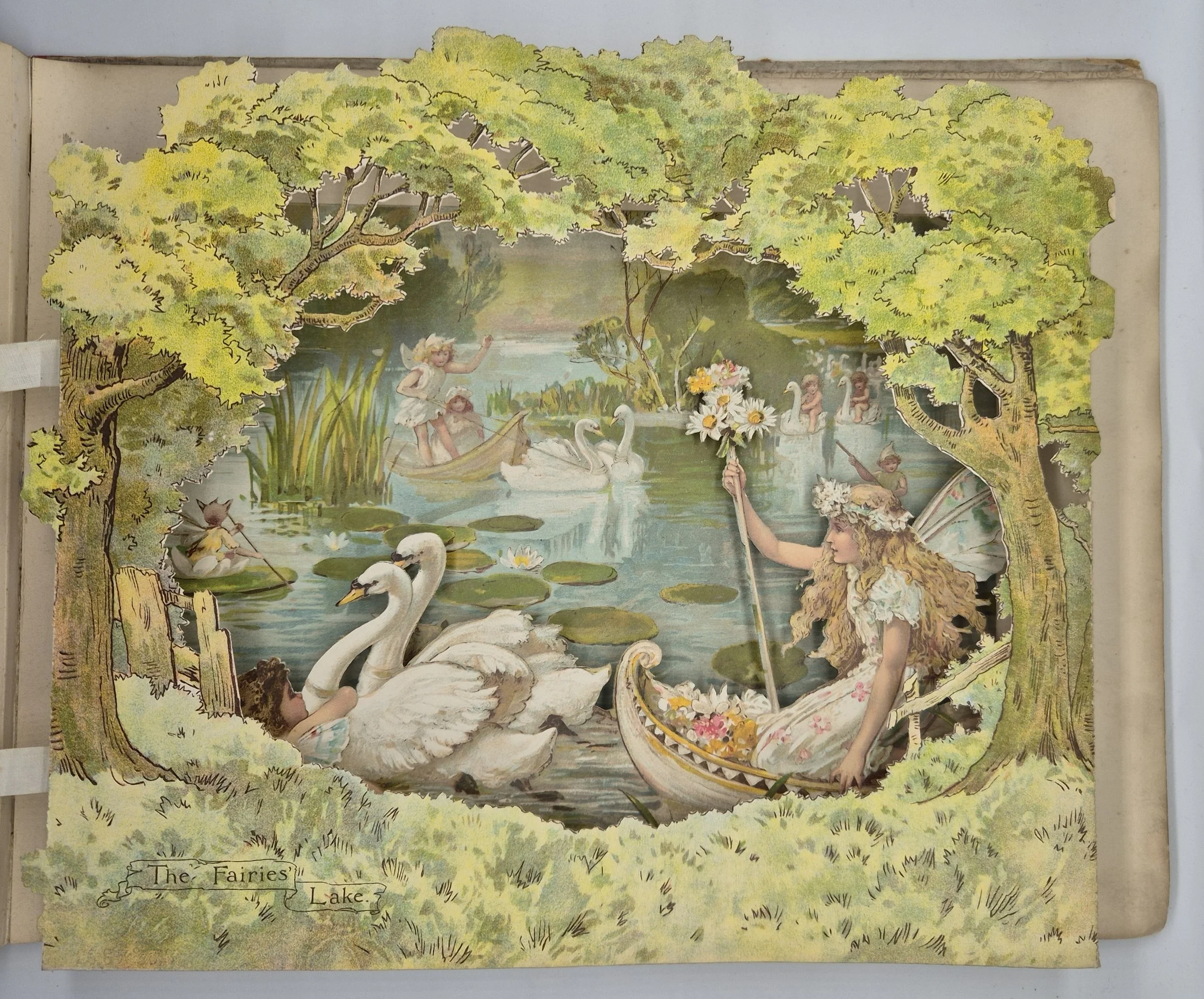
The Fairies’ Lake (in which a flower fairy is being pulled on a boat by two swans)
Jack running away from the Giant (with a castle in the background, Jack in the foreground holding his golden harp, and the giant behind him brandishing his club)
The Queen of the Bird Fairies (where the two children are surrounded in a woodland grotto by a series of winged beings)
and
The Babes Asleep in the Wood (another woodland scene with the two children sleeping beneath autumnal trees, while fairies dance in the background).
By the end of the 19th century, popularity for pop ups across the western world had rocketed. Encouraged by cheaper printing costs in Germany, a country which had pioneered the use of colour lithography in children’s books since its inception, many English and American companies at the time, including both Dutton in New York and Nister in the UK, had outsourced their printing to Germany, as in this example. The result is a beautiful production of fairytales which captured the public imagination at a time in which moving picture books were the epitome of childhood entertainment. This particular title is often cited as one of the finest examples of Nister’s stand up books.
As with all moveables and pop ups, it is scarce to find a publication such as this in such perfect working condition.
[POP UP BOOK]; F. E. WEATHERLY [Intro.]
Peeps into Fairy Land. A Panorama Picture Book of Fairy Stories.
London: Ernest Nister & New York, E. P. Dutton & Co., [c.1895]
Oblong folio., publisher’s decorative pictorial boards featuring two children aboard a leaf being pulled by harnessed robins; surrounded by a series of fairy folk; backed in red cloth; decorative floral endpapers; unpaginated [pp. xxviii]; illustrated title with line drawings, and further drawings in line surrounding text throughout; as well as six astonishing full-colour pop up lithographs, affixed to facing pages using tabs and creating multi-tiered scenes; the boards rather scratched and marked, as is common, ‘633’ (the number of the publication) written faintly to upper board; with some creases to the illustration and rubbing to corners and edges of boards showing some of the boards beneath; cloth nicked and faded at spine tips; a couple of small patches of wear; internally a very clean copy, with the hinges just a little cracked in places, very discretely repaired in places with archival tape; a little toning and fingers marking to the story pages, the pop ups themselves in fine, bright condition, fully functioning as issued; a lovely example of a work seldomly found with the pop ups in such bright condition.
First, and likely sole edition of this collection of fairy stories, printed in Bavaria. In order, the contained tales are:
Naughty Noel
The Fairy Fir-cones
The Fly-away Flock
Jack and the Beanstalk
The Blue Bird
and
The Babes in the Wood
The pop ups are:
The procession of Nursery Rhymes (featuring cherry blossom trees surrounding a scene with numerous children and fairy figures and animals)
A Visit to the Snow Queen’s Palace (showing two children in a wintry scene, adorned in fur coats, meeting a snow fairy sitting on a snowball)
The Fairies’ Lake (in which a flower fairy is being pulled on a boat by two swans)
Jack running away from the Giant (with a castle in the background, Jack in the foreground holding his golden harp, and the giant behind him brandishing his club)
The Queen of the Bird Fairies (where the two children are surrounded in a woodland grotto by a series of winged beings)
and
The Babes Asleep in the Wood (another woodland scene with the two children sleeping beneath autumnal trees, while fairies dance in the background).
By the end of the 19th century, popularity for pop ups across the western world had rocketed. Encouraged by cheaper printing costs in Germany, a country which had pioneered the use of colour lithography in children’s books since its inception, many English and American companies at the time, including both Dutton in New York and Nister in the UK, had outsourced their printing to Germany, as in this example. The result is a beautiful production of fairytales which captured the public imagination at a time in which moving picture books were the epitome of childhood entertainment. This particular title is often cited as one of the finest examples of Nister’s stand up books.
As with all moveables and pop ups, it is scarce to find a publication such as this in such perfect working condition.