

 Image 1 of 2
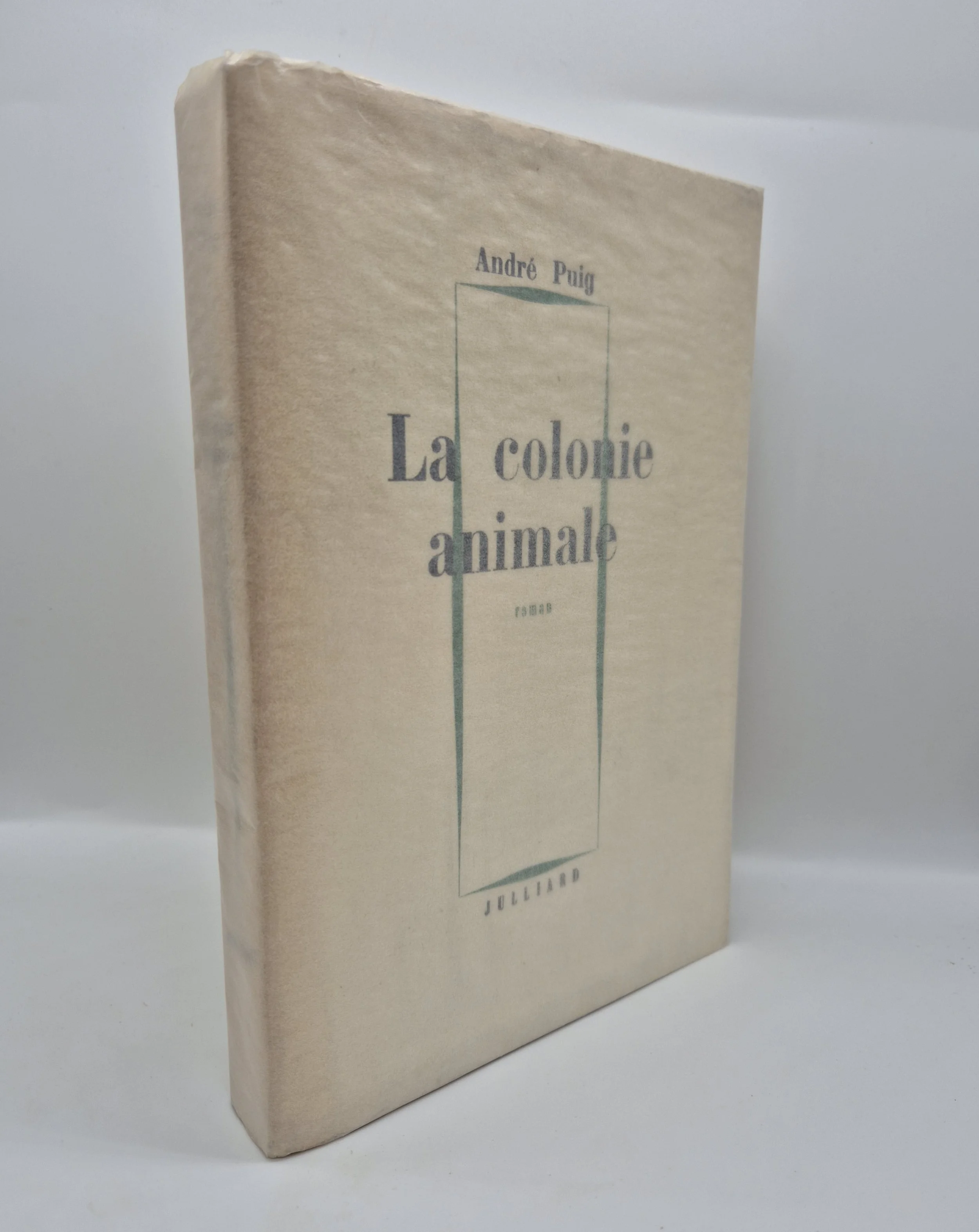 Image 2 of 2
FROM SARTRE’S PERSONAL LIBRARY, INSCRIBED TO HIM FROM THE AUTHOR, HIS SECRETARY
PUIG, André
La colonie animale
Paris: René Julliard, 1963
8vo., original cream card wraps, lettered and decorated in green and black to upper cover and spine; together in the original publisher’s glassine wrapper; outer edges untrimmed; pp. [xi], 12-346, [ii]; an excellent, near-fine example, many of the pages entirely unopened, occasional light creases to the text block, but otherwise clean and bright with a couple of tiny nicks to the edges of covers and just beginning to pull at internal gutters.
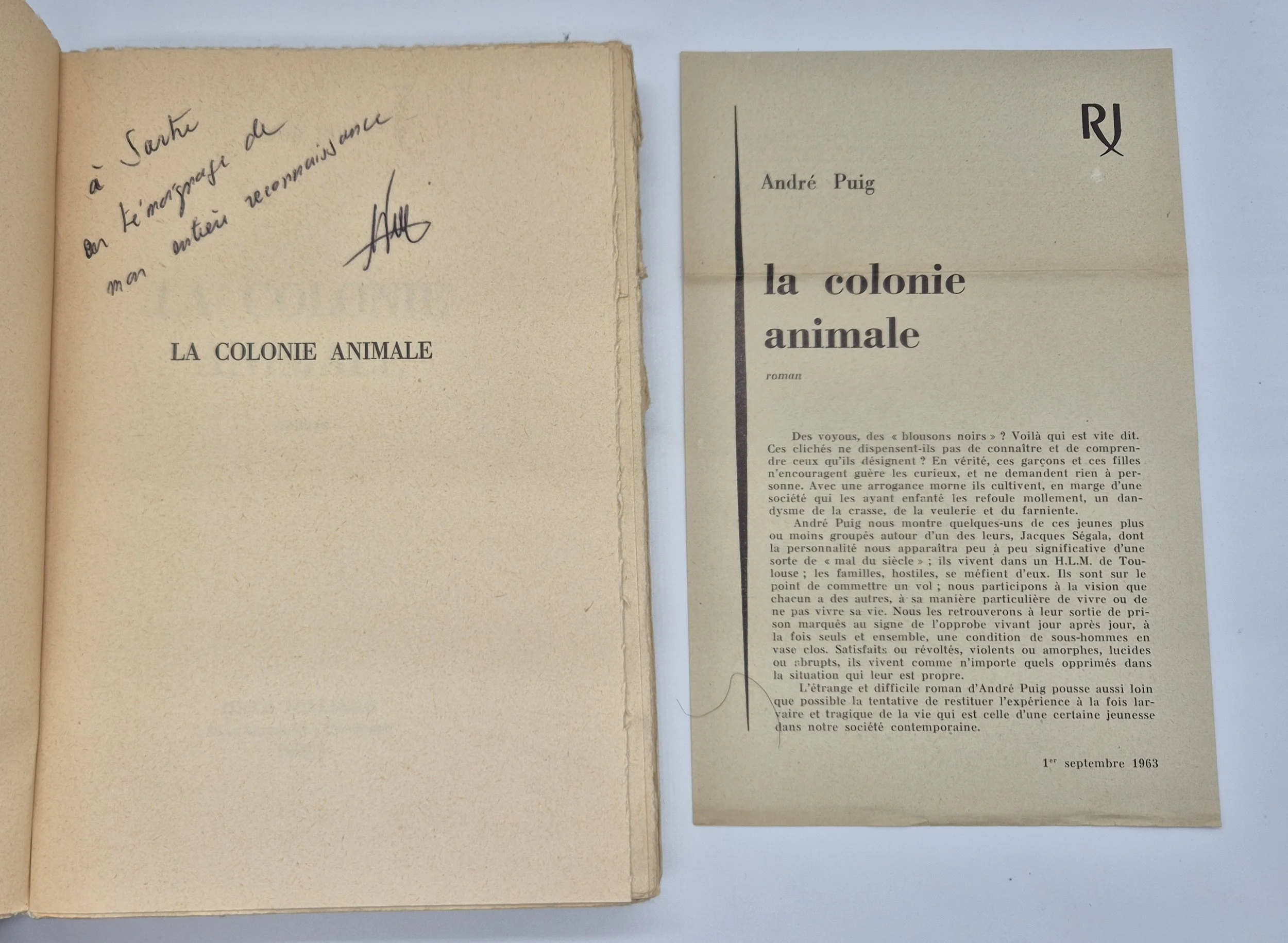
Service de Presse copy, with ‘S.P’ printed in black to the lower cover. This a presentation copy from the author, inscribed and signed to the half title: “à Sartre en témoignage de mon entière reconnaissance - André Puig”. Together with the publisher’s original advertisement slip, dated 1st September 1963, also loosely laid in.
Born in 1939, Puig was perhaps destined to become something of a rebel. His father, latterly a postman, had in his younger years helped Spanish Republican refugees cross the border and escape from French camps, and from a young age Puig showed a resistance to authority. He was expelled from school for insubordination and poor work, and even spent a short time in prison. Called up for military service in Algeria, it was while he was still in the army that he sent a manuscript to Sartre who, after reading it, suggested that the young Puig come and see him when he was discharged.
Puig arrived in Paris in 1962, and became friends with Arlette Elkaïm, Sartre’s close confidant and sometime lover. “We saw a frail young man arrive, wearing an old black imitation leather jacket, with slightly hunched shoulders”, Elkaïm later recalled. “ He had read ‘Situations I’, the first volume of Sartre’s literary criticism, and had been curious enough to read the novels Sartre had discussed. He had been captivated by those of Faulkner and Dos Passos...” Elkaïm and Puig both published works in Les Temps modernes, the journal which had been founded by Sartre together with Simone de Beauvoir and Maurice Merleau-Ponty in 1945. The following year this, Puig’s first novel, was published with Sartre’s influence and guidance. The book tells a fictionalised account of the author’s early life and association with other ‘leather-jacketed youths’, rejected by the society which birthed them, and about to commit a robbery. Immediately after reading it, Sartre gave the work its present title, ‘The Animal Colony’, inspired by the sense of animalistic belonging of a group of dispirited youths disillusioned with the world around them. Sartre then offered Puig the position of his personal secretary, a role which Puig held until Sartre passed away in 1980. He also wrote the introduction to Puig’s second, and perhaps best-known novel, L'Inachevé (The Unfinished ), which was published by Gallimard in 1970.
A fabulous association copy, in which Puig writes of his “complete gratitude” to the man who helped to launch his career. In fact, when Sartre died, Puig refused to publish another work under any other imprint, effectively ending his literary occupation.
Genuinely rare thus.
FROM SARTRE’S PERSONAL LIBRARY, INSCRIBED TO HIM FROM THE AUTHOR, HIS SECRETARY
PUIG, André
La colonie animale
Paris: René Julliard, 1963
8vo., original cream card wraps, lettered and decorated in green and black to upper cover and spine; together in the original publisher’s glassine wrapper; outer edges untrimmed; pp. [xi], 12-346, [ii]; an excellent, near-fine example, many of the pages entirely unopened, occasional light creases to the text block, but otherwise clean and bright with a couple of tiny nicks to the edges of covers and just beginning to pull at internal gutters.
Service de Presse copy, with ‘S.P’ printed in black to the lower cover. This a presentation copy from the author, inscribed and signed to the half title: “à Sartre en témoignage de mon entière reconnaissance - André Puig”. Together with the publisher’s original advertisement slip, dated 1st September 1963, also loosely laid in.
Born in 1939, Puig was perhaps destined to become something of a rebel. His father, latterly a postman, had in his younger years helped Spanish Republican refugees cross the border and escape from French camps, and from a young age Puig showed a resistance to authority. He was expelled from school for insubordination and poor work, and even spent a short time in prison. Called up for military service in Algeria, it was while he was still in the army that he sent a manuscript to Sartre who, after reading it, suggested that the young Puig come and see him when he was discharged.
Puig arrived in Paris in 1962, and became friends with Arlette Elkaïm, Sartre’s close confidant and sometime lover. “We saw a frail young man arrive, wearing an old black imitation leather jacket, with slightly hunched shoulders”, Elkaïm later recalled. “ He had read ‘Situations I’, the first volume of Sartre’s literary criticism, and had been curious enough to read the novels Sartre had discussed. He had been captivated by those of Faulkner and Dos Passos...” Elkaïm and Puig both published works in Les Temps modernes, the journal which had been founded by Sartre together with Simone de Beauvoir and Maurice Merleau-Ponty in 1945. The following year this, Puig’s first novel, was published with Sartre’s influence and guidance. The book tells a fictionalised account of the author’s early life and association with other ‘leather-jacketed youths’, rejected by the society which birthed them, and about to commit a robbery. Immediately after reading it, Sartre gave the work its present title, ‘The Animal Colony’, inspired by the sense of animalistic belonging of a group of dispirited youths disillusioned with the world around them. Sartre then offered Puig the position of his personal secretary, a role which Puig held until Sartre passed away in 1980. He also wrote the introduction to Puig’s second, and perhaps best-known novel, L'Inachevé (The Unfinished ), which was published by Gallimard in 1970.
A fabulous association copy, in which Puig writes of his “complete gratitude” to the man who helped to launch his career. In fact, when Sartre died, Puig refused to publish another work under any other imprint, effectively ending his literary occupation.
Genuinely rare thus.