

 Image 1 of 5
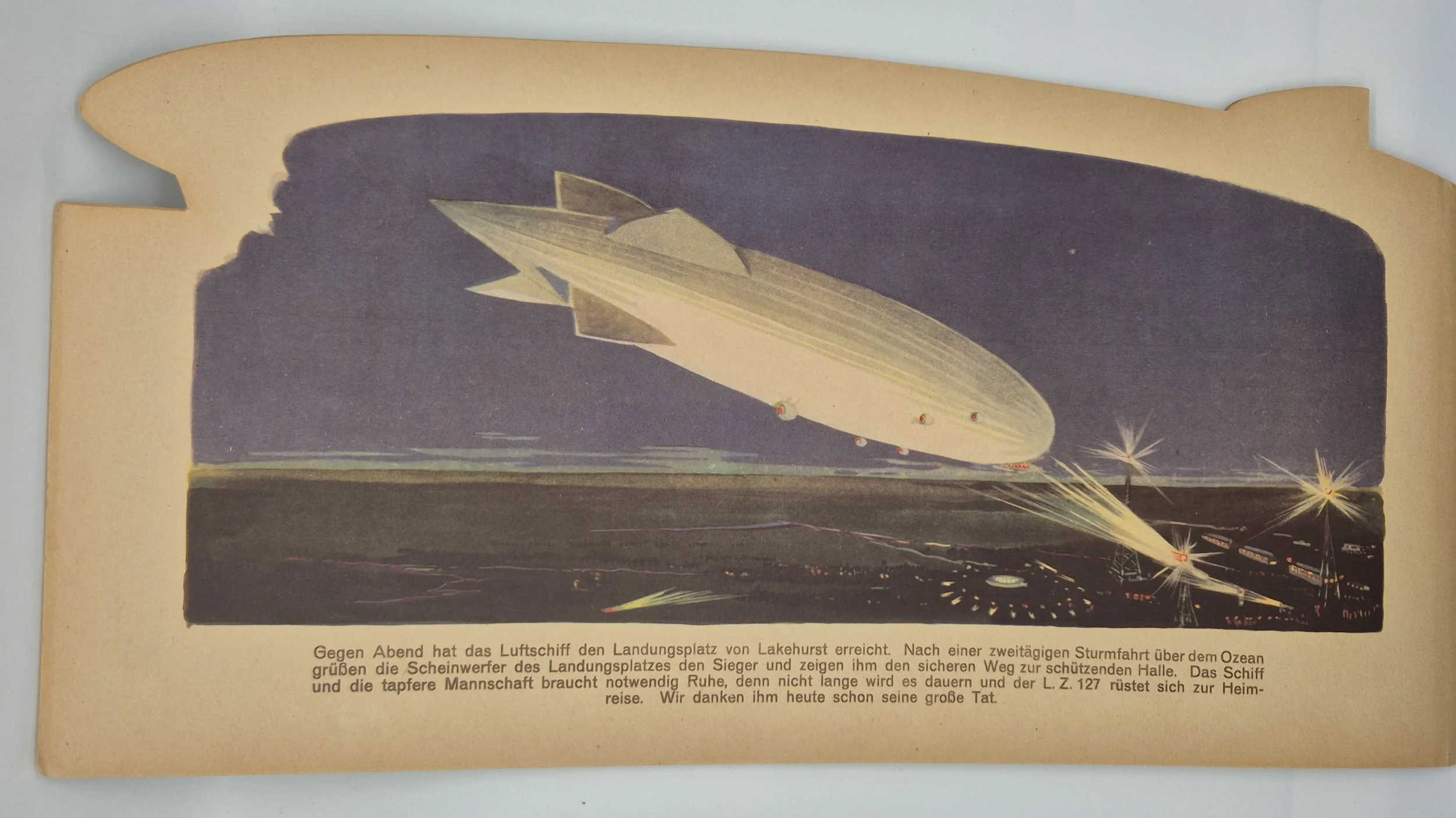 Image 2 of 5
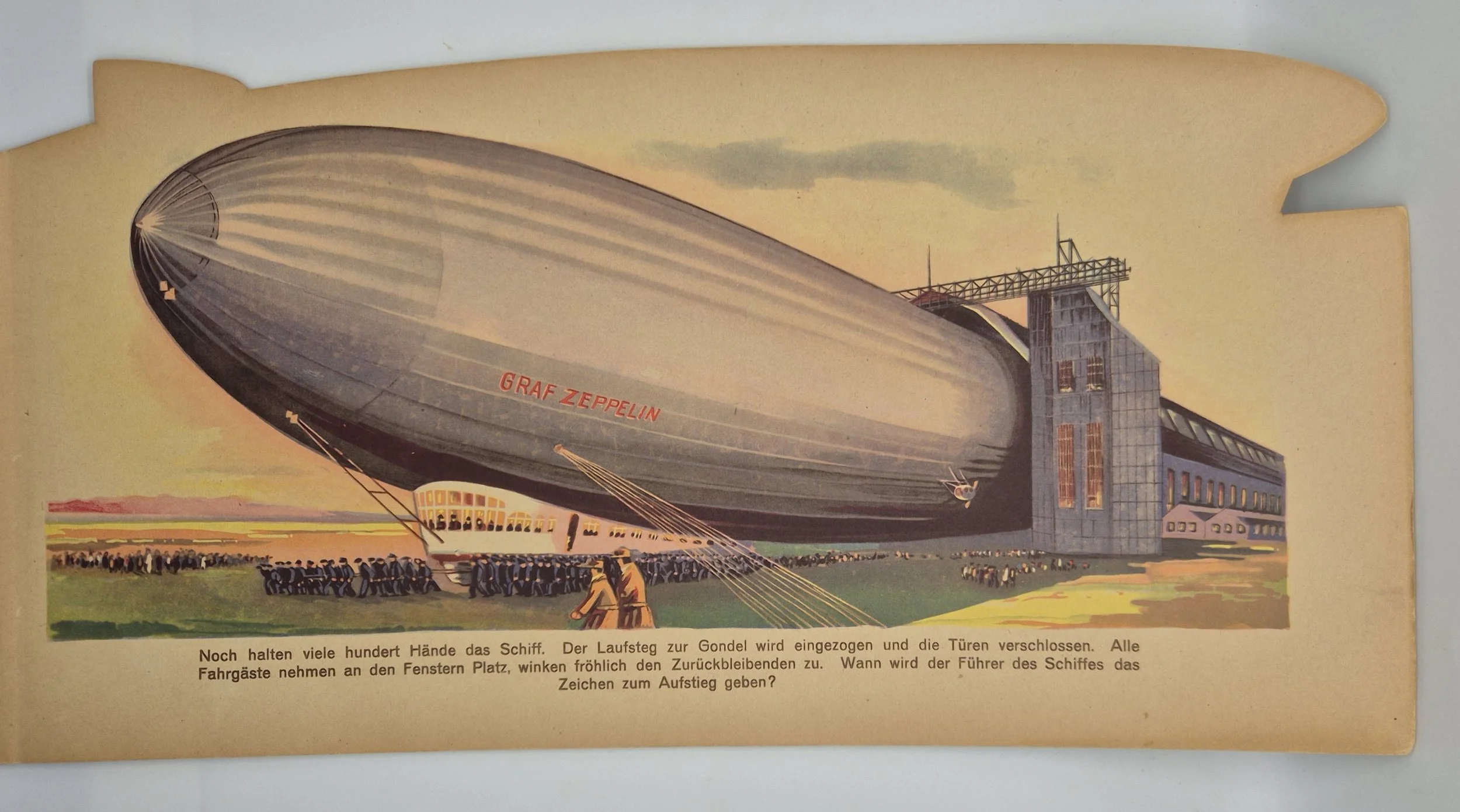 Image 3 of 5
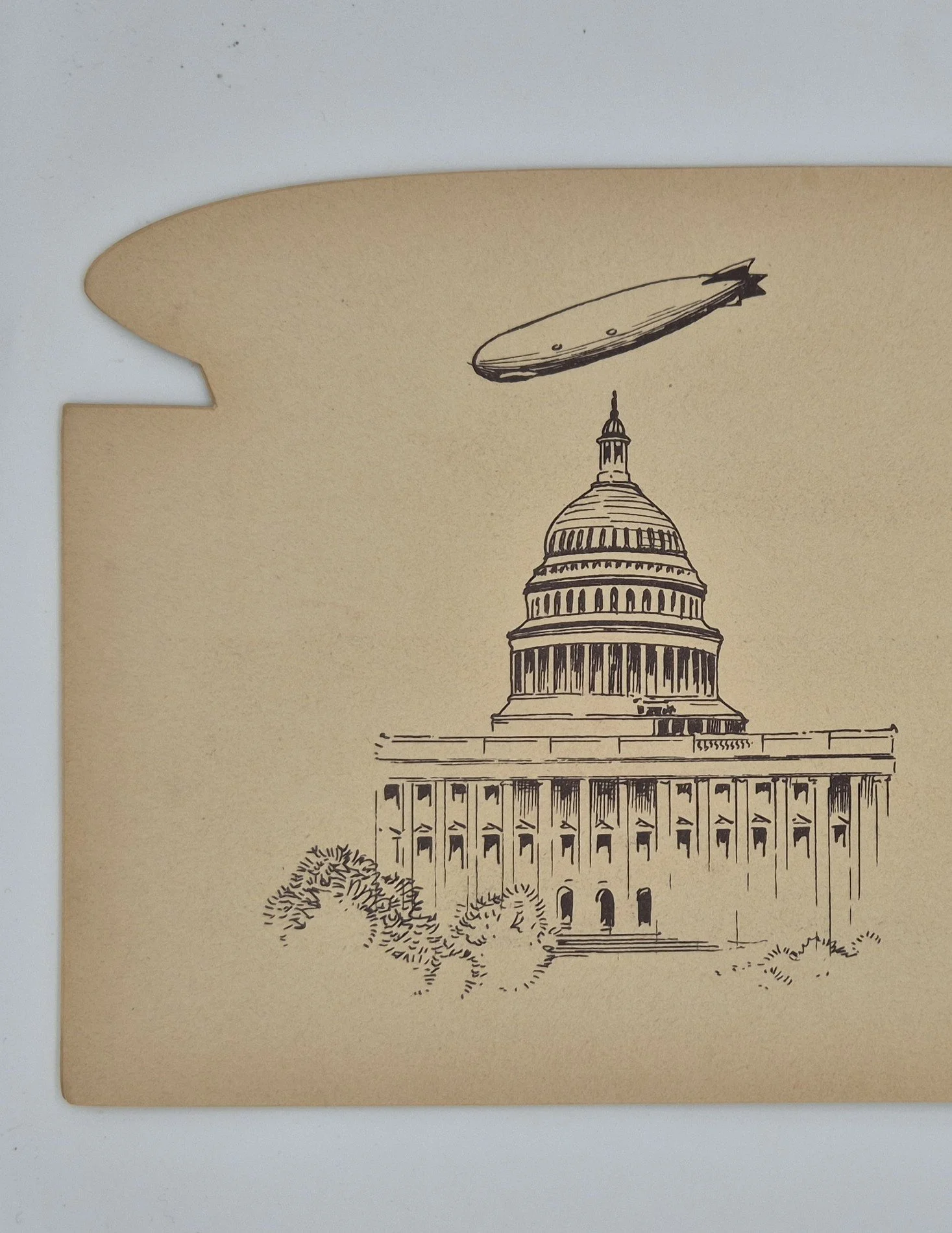 Image 4 of 5
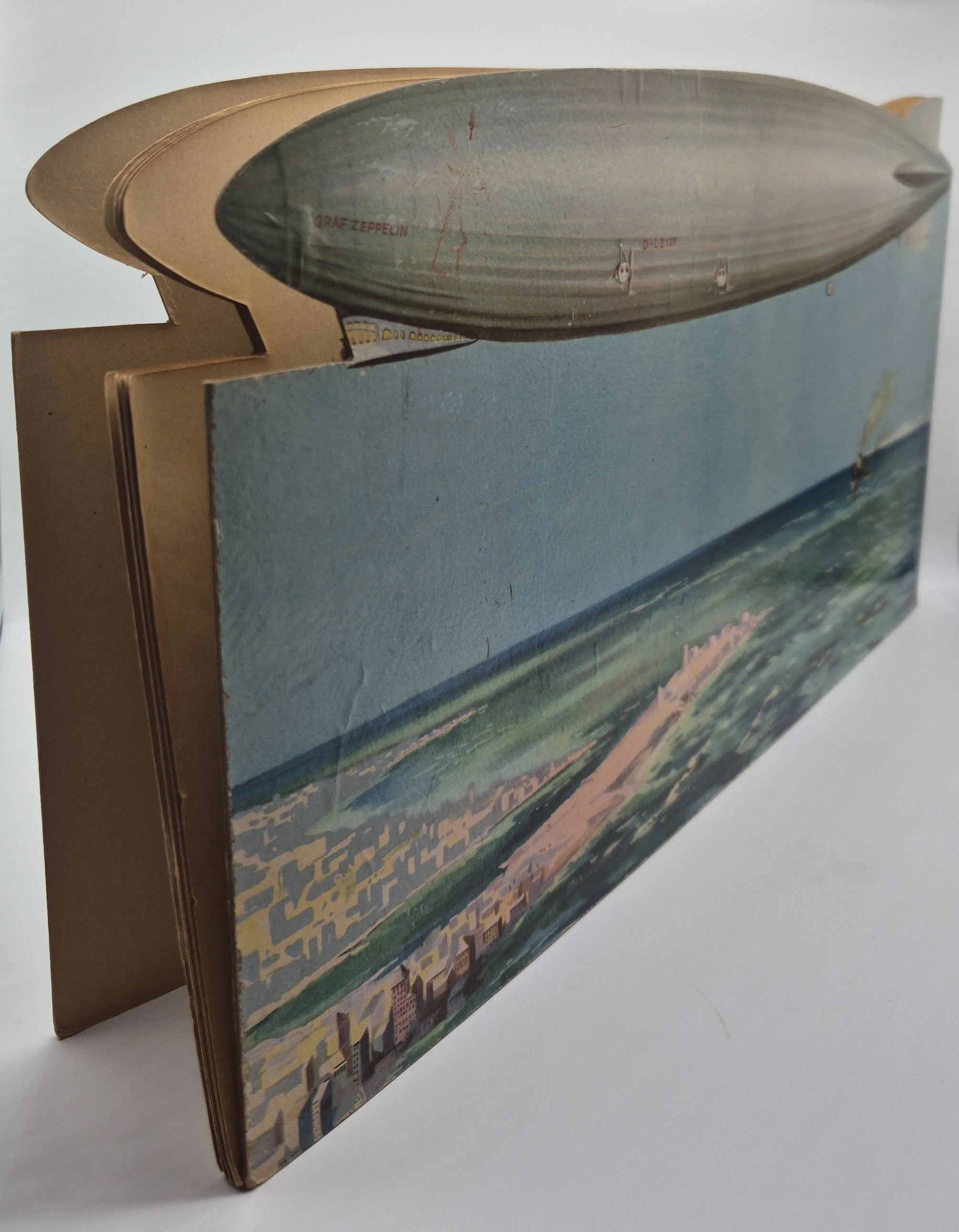 Image 5 of 5
“Like a ghost ship from the fairytale book ‘One Thousand and One Nights’, this air giant glides across the earth. A dream dreamt decades ago has thus become reality…”
[AIRSHIPS]
Graf Zeppelin D-LZ127
[Nuremberg]: [c.1930]
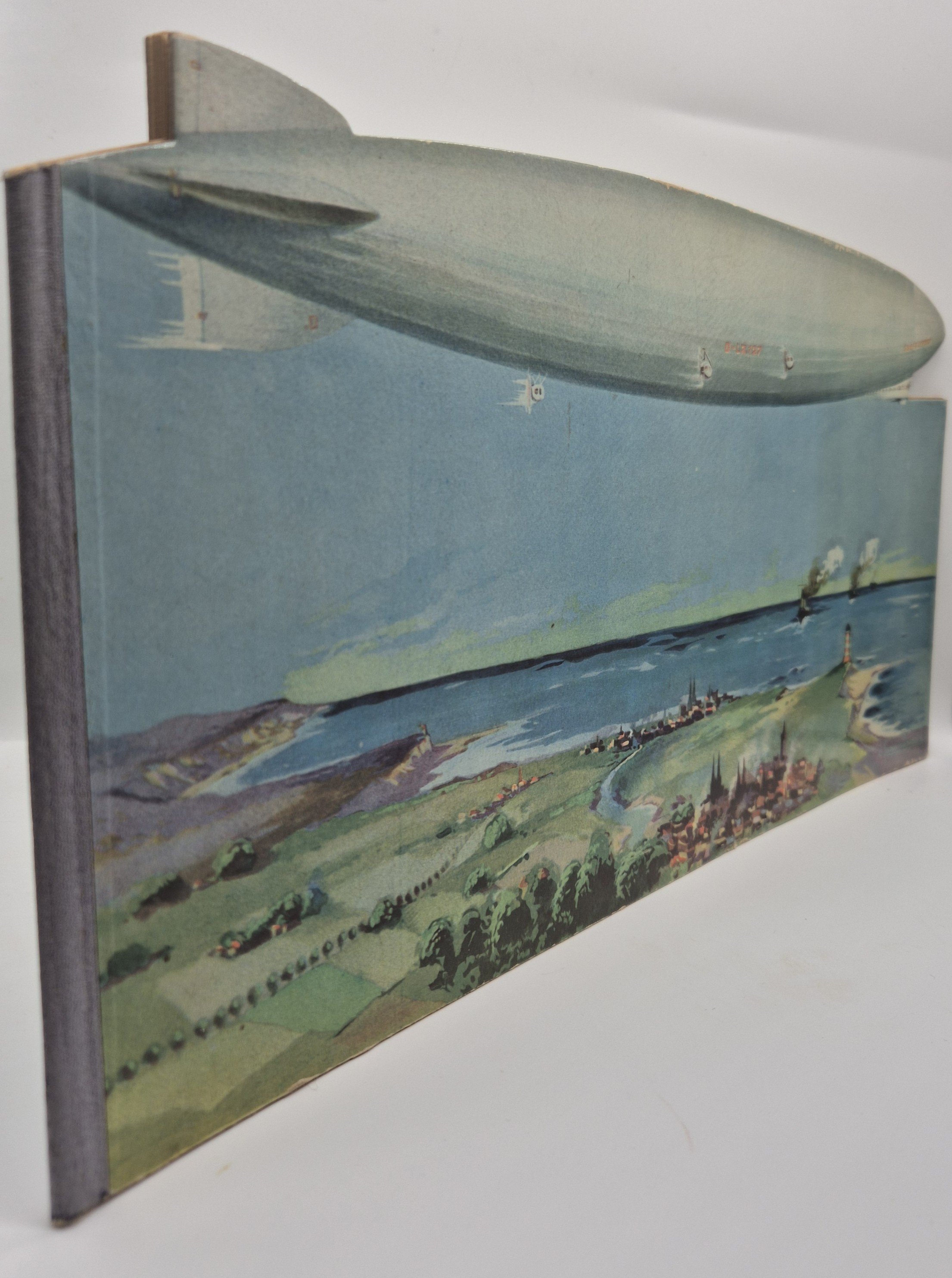
Oblong shape book ( 20 x 40cm approx) showing full colour illustrations of the Graf Zeppelin D-LZ127 to both boards; backed in blue cloth; pp. [xii], with text and illustrations in black and white throughout, including to inside covers, as well as a further six wonderful illustrations in full colour, all by Curt Junghändel; boards ever-so-slightly warped, very minimal scuffing to edges; with some very tiny bubbles and scratches to the lower board, and a couple of red marks to the same; the internal pages lightly and evenly toned, as is common, but else exceptionally near-fine.
A wonderful, and genuinely rare children’s shape book dating from the 1930s. Inside the illustrated boards are facts and figures about the ship’s construction (explaining that the ship is 236 metres in length, contains 10 cabins, etc.), and depictions of all of its parts, including the control room, the kitchen, the passenger compartment, travels over the ocean, and the evening landing approach at Lakehurst, near New York after a stormy journey over the ocean (and showing it, in several illustrations, sailing above the Capitol building, the White House, and the Woolworth building which was, at the time, the tallest building in the world). This publication would also have been used as a very limited, promotional publication to encourage travellers to purchase tickets for international travel.
The Graf Zeppelin was the first commercial transatlantic passenger flight service, with its first flight being the 18th September 1928, after 21 months of construction. Printed just a few years before the outbreak of the Second World War, the publication heralds a machine which has “built a bridge from us to the people across the ocean, a bridge that contributes to the understanding and reconciliation between nations”. Sadly, that was not to be, and when the Nazis came to power, this machine was used as a propaganda tool. It was finally retired in 1937 and scrapped for military aircraft production after 590 flights totalling almost 1.7 million kilometres.
Predating this time, however, this c. 1930s publication represents a time of great excitement for the German people, and the book is greatly enhanced by the enigmatic illustrations carried out by C. Junghandel, a German illustrator and graphic artist who worked during the late Weimar Republic, a time of great momentum and change in the world of speed and modernity, specifically in regards to aviation technologies. His illustrations here are typical of his work, with flowing shapes, stylised landscapes and a sense of scale - showing the giant ship sailing above tiny towns, boats, and coastal scenes. Often commissioned to produce images of Zeppelins, this approach made the ships look heroic, as well as approachable and friendly - ideal for children growing up at the time in a country fascinated by the progression of technology.
Seldom found in commerce, especially so in this condition. This is only the second copy this bookseller has handled.
“Like a ghost ship from the fairytale book ‘One Thousand and One Nights’, this air giant glides across the earth. A dream dreamt decades ago has thus become reality…”
[AIRSHIPS]
Graf Zeppelin D-LZ127
[Nuremberg]: [c.1930]
Oblong shape book ( 20 x 40cm approx) showing full colour illustrations of the Graf Zeppelin D-LZ127 to both boards; backed in blue cloth; pp. [xii], with text and illustrations in black and white throughout, including to inside covers, as well as a further six wonderful illustrations in full colour, all by Curt Junghändel; boards ever-so-slightly warped, very minimal scuffing to edges; with some very tiny bubbles and scratches to the lower board, and a couple of red marks to the same; the internal pages lightly and evenly toned, as is common, but else exceptionally near-fine.
A wonderful, and genuinely rare children’s shape book dating from the 1930s. Inside the illustrated boards are facts and figures about the ship’s construction (explaining that the ship is 236 metres in length, contains 10 cabins, etc.), and depictions of all of its parts, including the control room, the kitchen, the passenger compartment, travels over the ocean, and the evening landing approach at Lakehurst, near New York after a stormy journey over the ocean (and showing it, in several illustrations, sailing above the Capitol building, the White House, and the Woolworth building which was, at the time, the tallest building in the world). This publication would also have been used as a very limited, promotional publication to encourage travellers to purchase tickets for international travel.
The Graf Zeppelin was the first commercial transatlantic passenger flight service, with its first flight being the 18th September 1928, after 21 months of construction. Printed just a few years before the outbreak of the Second World War, the publication heralds a machine which has “built a bridge from us to the people across the ocean, a bridge that contributes to the understanding and reconciliation between nations”. Sadly, that was not to be, and when the Nazis came to power, this machine was used as a propaganda tool. It was finally retired in 1937 and scrapped for military aircraft production after 590 flights totalling almost 1.7 million kilometres.
Predating this time, however, this c. 1930s publication represents a time of great excitement for the German people, and the book is greatly enhanced by the enigmatic illustrations carried out by C. Junghandel, a German illustrator and graphic artist who worked during the late Weimar Republic, a time of great momentum and change in the world of speed and modernity, specifically in regards to aviation technologies. His illustrations here are typical of his work, with flowing shapes, stylised landscapes and a sense of scale - showing the giant ship sailing above tiny towns, boats, and coastal scenes. Often commissioned to produce images of Zeppelins, this approach made the ships look heroic, as well as approachable and friendly - ideal for children growing up at the time in a country fascinated by the progression of technology.
Seldom found in commerce, especially so in this condition. This is only the second copy this bookseller has handled.