

 Image 1 of 2
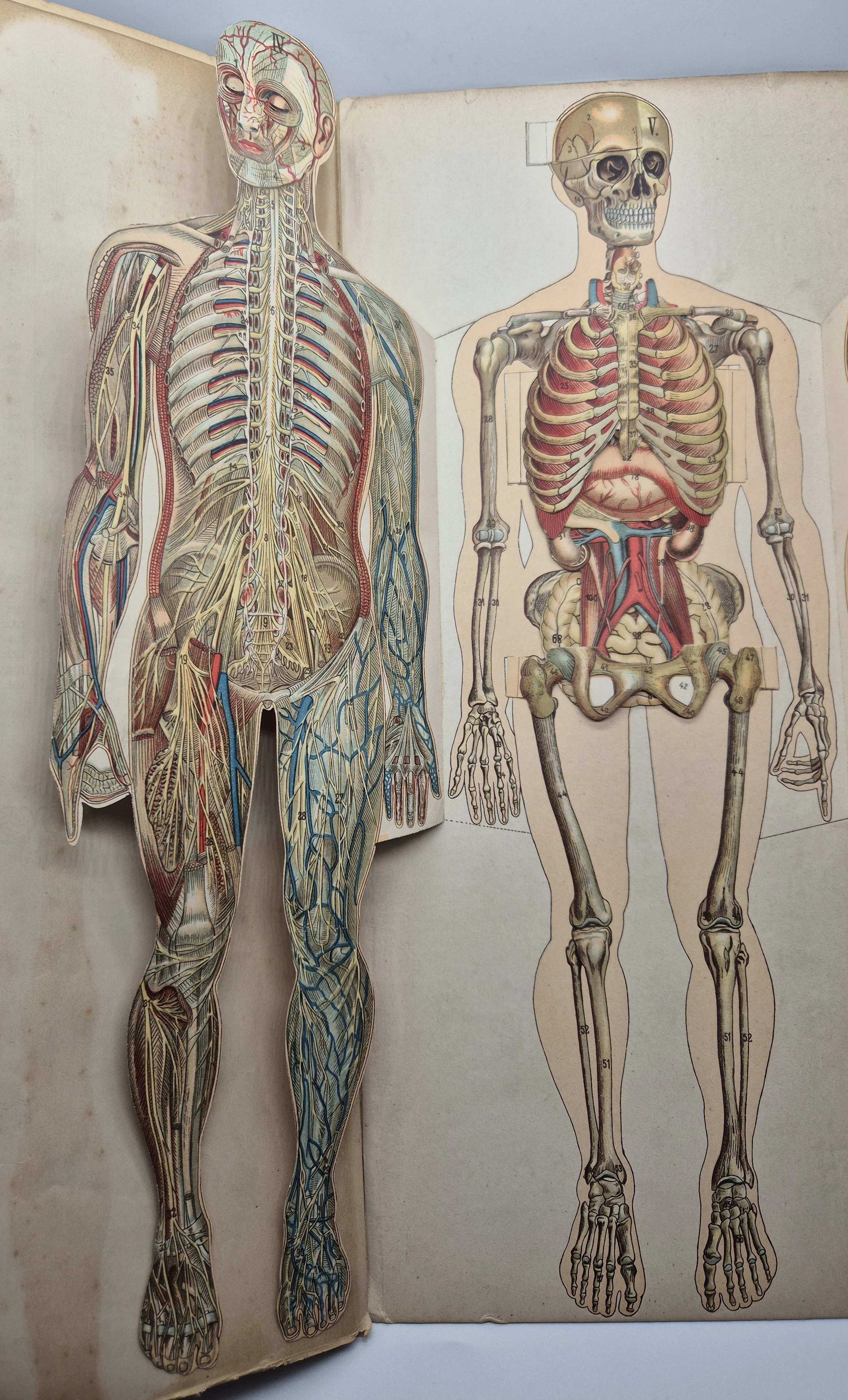 Image 2 of 2
FURNEAUX., W. S.
Baillière’s Popular Manikin
London: Baillière, Tindall & Cox, [c.1900]
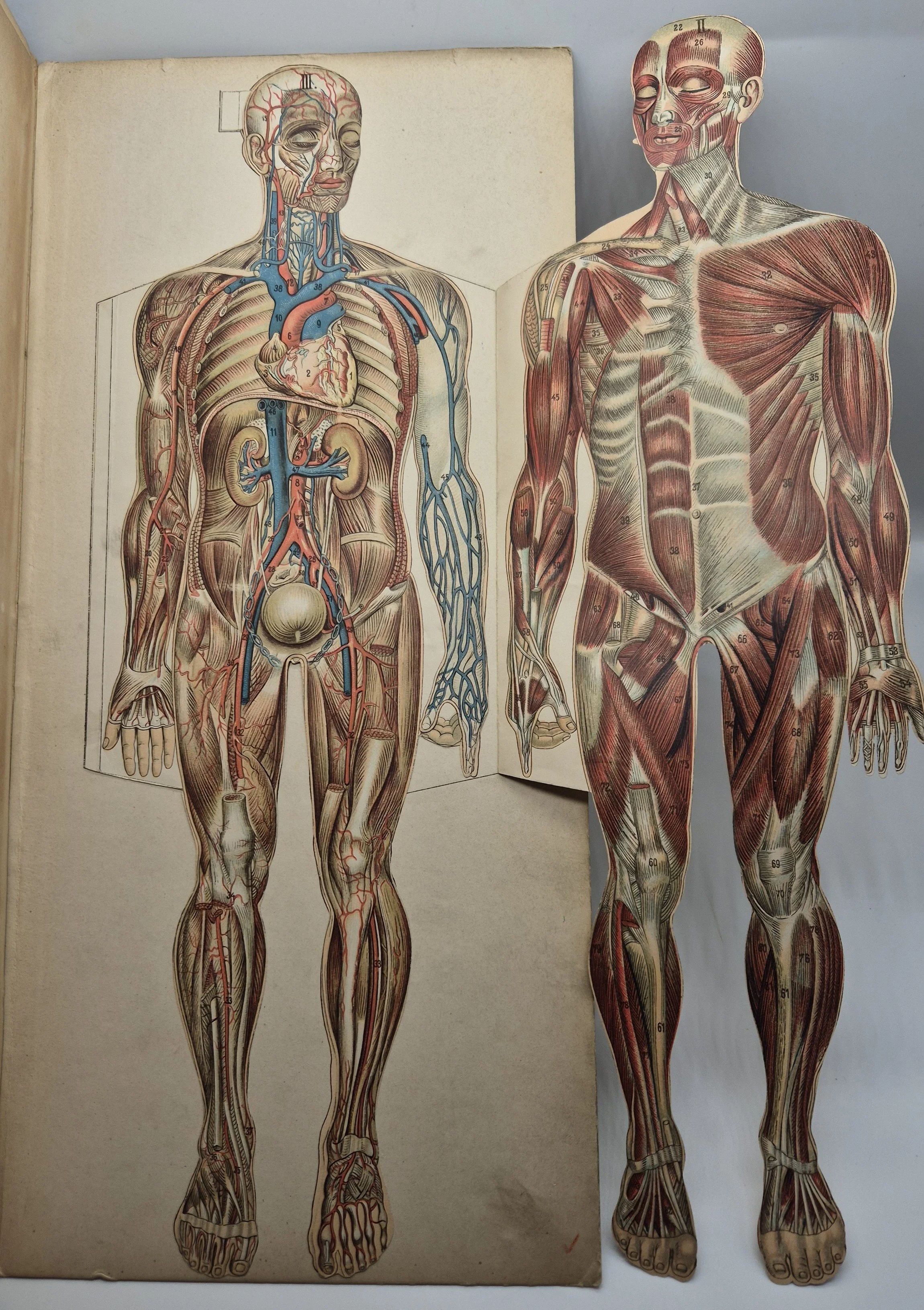
Tall thin folio., red cloth-backed illustrated boards, the upper board printed with text in black and showing the internal organs of a moustached man in full colour; pp. 3 pages of text followed by the folding body chart, chromolithographically printed in full colour, with 15 outwardly-folding parts showing the organs of the chest and abdomen; the anterior muscles; the circulatory system; the nervous system; the internal organs and the skeleton, respectively; containing, in total, 277 labelled parts; boards a little darkened with some marks and creases and some chipping and rubbing to edges, sometimes showing board beneath; first text page rather heavily browned; the others a little creased and spotted; figure offset onto facing page; the folding diagram itself in excellent bright condition, far superior to those often found; with just three loose parts; 101 (the bladder), 09 (trunk of the pulmonary artery), and intestines (85-91).
A wonderful example of this practical folding medical chart. Originally issued in the 1890s, editions such as these were reprinted well into the 1930s, and as they were intended for education use, to find an example with the parts so intact is unusual.
Millinikin & Lawley was a prominent 19th-century London-based supplier of medical, osteological, and scientific instruments, originally established by John Millikin in 1815. Having commissioned the plates, William S. Furneaux was hired to write the descriptions. Furneaux was a popular science teacher and writer of educational books which also included such titles as ‘The Outdoor World’ (1893) and ‘Life in Ponds and Streams’ (1896). “He had the knack of writing just the sort of succinct and well-illustrated practical book which stimulated the young collector to hunt for spoils and afterwards to pore over the naming of them”, one reviewer wrote in his obituary for Nature, “and his publishers aided and abetted with that profusion of coloured plates which added attractiveness to utility.”
OCLC lists just one copy of this particular edition in the UK, fittingly at the Wellcome.
FURNEAUX., W. S.
Baillière’s Popular Manikin
London: Baillière, Tindall & Cox, [c.1900]
Tall thin folio., red cloth-backed illustrated boards, the upper board printed with text in black and showing the internal organs of a moustached man in full colour; pp. 3 pages of text followed by the folding body chart, chromolithographically printed in full colour, with 15 outwardly-folding parts showing the organs of the chest and abdomen; the anterior muscles; the circulatory system; the nervous system; the internal organs and the skeleton, respectively; containing, in total, 277 labelled parts; boards a little darkened with some marks and creases and some chipping and rubbing to edges, sometimes showing board beneath; first text page rather heavily browned; the others a little creased and spotted; figure offset onto facing page; the folding diagram itself in excellent bright condition, far superior to those often found; with just three loose parts; 101 (the bladder), 09 (trunk of the pulmonary artery), and intestines (85-91).
A wonderful example of this practical folding medical chart. Originally issued in the 1890s, editions such as these were reprinted well into the 1930s, and as they were intended for education use, to find an example with the parts so intact is unusual.
Millinikin & Lawley was a prominent 19th-century London-based supplier of medical, osteological, and scientific instruments, originally established by John Millikin in 1815. Having commissioned the plates, William S. Furneaux was hired to write the descriptions. Furneaux was a popular science teacher and writer of educational books which also included such titles as ‘The Outdoor World’ (1893) and ‘Life in Ponds and Streams’ (1896). “He had the knack of writing just the sort of succinct and well-illustrated practical book which stimulated the young collector to hunt for spoils and afterwards to pore over the naming of them”, one reviewer wrote in his obituary for Nature, “and his publishers aided and abetted with that profusion of coloured plates which added attractiveness to utility.”
OCLC lists just one copy of this particular edition in the UK, fittingly at the Wellcome.